As anxiety and digital fatigue rise among college students, alumna Emma Pettitt wondered what might happen if prayer replaced social media.
A Question Sparked by Digital Overload
That idea grew into a research study now shaping conversations about mental health, spiritual discipline, and digital habits on campus. It also invited students to take an honest look at how much time they spend scrolling and what might happen if that time were redirected toward practices that draw them into deeper relationship with Christ.
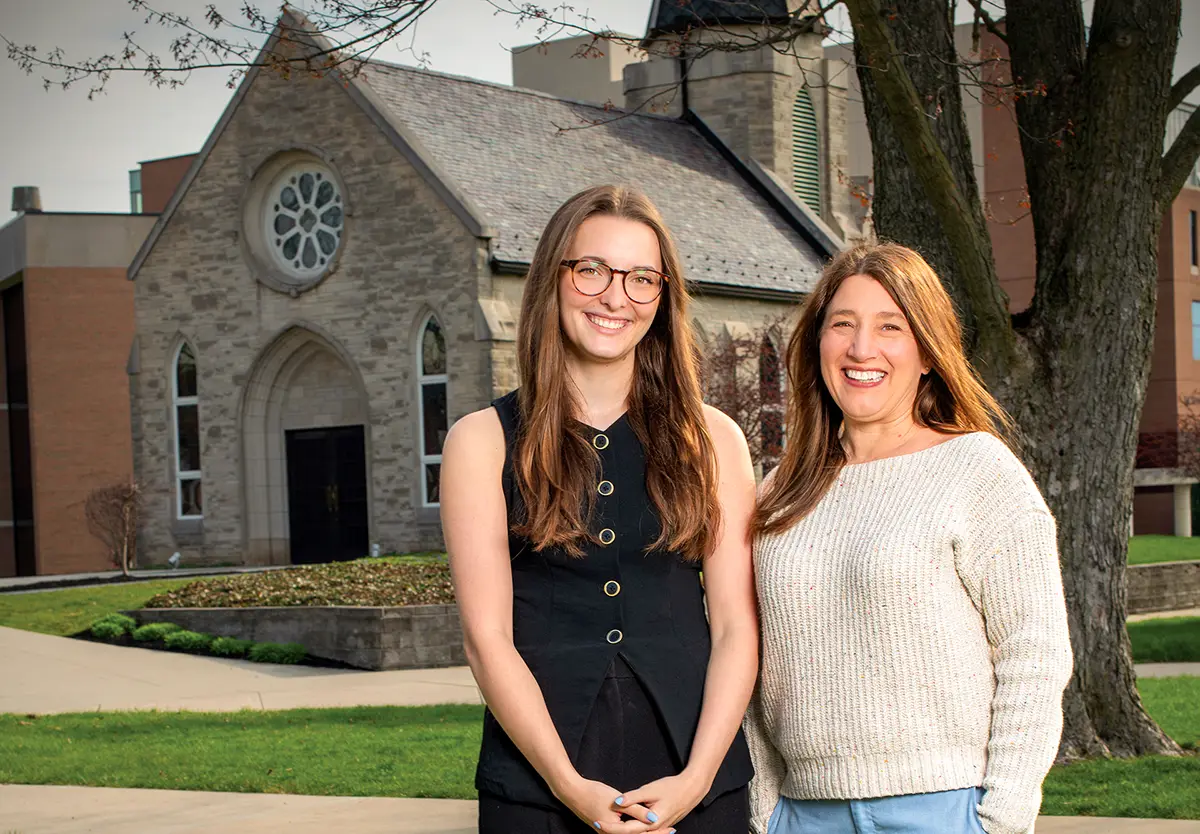
In 2025, recent IWU graduate Emma Pettitt partnered with IWU psychology professor Erin Devers, Ph.D., to present their findings at the Christian Association for Psychological Studies Conference. Their two-semester project explored whether prayer could meaningfully substitute for social media and what impact such a shift might have on student well-being. The results were striking, showing improvements in anxiety, self-control, and spiritual clarity. “I don’t think there was a single person in the study who said they would rather be on social media all the time,” Pettitt said. “Everyone knew it was a problem to some extent.”
How The Research Took Shape
The idea began in Pettitt’s senior capstone project in IWU’s John Wesley Honors College. Influenced by John Mark Comer’s “The Ruthless Elimination of Hurry,” she wanted to understand how removing digital distractions might create more space for prayer. Early conversations confirmed that many students felt overwhelmed by social media and wished they had stronger spiritual habits but struggled to make consistent changes.
Seeking guidance, Pettitt partnered with Devers, whose background in mental health research aligned well with the project. Devers immediately recognized the potential. “Research is only boring if you’re asking a boring question,” she said. “If you’re asking an interesting one, research is fascinating.” The student response affirmed that the topic mattered. “The form to sign up for the study filled up almost immediately,” Pettitt said.
The first study in spring 2024 included 50 students who abstained completely from social media for six weeks. The second study in fall 2024 expanded to 150 participants and introduced a comparison group. One group completed the same fast, while another limited social media use to 30 minutes per day.
Both groups received weekly prayer prompts and encouraging text messages designed to help participants stay focused as they shifted from instant digital gratification to slower, more intentional prayer practices.
Participants completed surveys at the beginning, midpoint, and conclusion of the study to measure anxiety, stress, and prayer habits. Because the three-week mark was the hardest, Pettitt and Devers sent tailored encouragement messages to help students stay motivated.
Meaningful Results and Broader Impact
Both studies produced consistent findings. Students reported decreased anxiety, loneliness, and stress, along with stronger prayer habits and improved self-control. A surprising discovery was how little difference there was between quitting social media entirely and reducing it to 30 minutes per day. “I thought quitting cold turkey would be more powerful, but the data showed otherwise,” Pettitt said. “Intentionality matters more than total abstinence.”
At the closing meeting of the second study, students reflected on the changes they experienced. One described gaining “a new sense of clarity,” comparing social media to the constant hum of a box fan. Reducing it felt like turning off noise they had unknowingly grown accustomed to.
The project also generated community impact. Each participant donated to Hope House, a sober-living community in Marion, Indiana, home to IWU’s main campus. More than $3,000 was raised to support addiction recovery efforts. Pettitt noted that while social media addiction is not the same as substance abuse, it operates through similar psychological pathways and can influence behavior in comparable ways.
Takeaways For Faith, Well-Being, And Student Growth
The research highlighted not only the emotional grip social media exerts on students but also the power of small, intentional spiritual practices.
Students discovered that creating even modest boundaries around social media opened space for clarity, prayer, and healthier mental patterns. Pettitt found her own confidence growing as well. Leading the project helped her overcome self-doubt and recognize her ability to manage a significant research initiative from start to finish.
For Pettitt and Devers, the takeaway is clear. Spiritual and emotional renewal often begins not with dramatic changes, but with the willingness to create margin. “The study wasn’t about us doing anything extraordinary,” Pettitt said. “We just created space for Jesus to move. And He did.”