A hospital room has a way of testing theology.
In the classroom, a seminarian may spend hours tracing the meaning of a passage, parsing Greek verbs, weighing context, and learning to speak truthfully about God. But at a bedside, with grief in the room and no easy answer to offer, theology must become more than accuracy. It must become presence, prayer, and the steady mercy of Jesus.
These are the moments that shape pastors.
At Wesley Seminary, pastoral formation does not take place in classrooms alone. Through the seminary’s field education program, students serve in churches, hospitals, and other ministry settings while completing their studies. There, what is learned in lectures and readings is carried into real lives and real suffering. Scripture moves from interpretation to proclamation. Doctrine is no longer abstract. It is tested, embodied, and refined in the presence of people who are hurting, searching, and hoping.
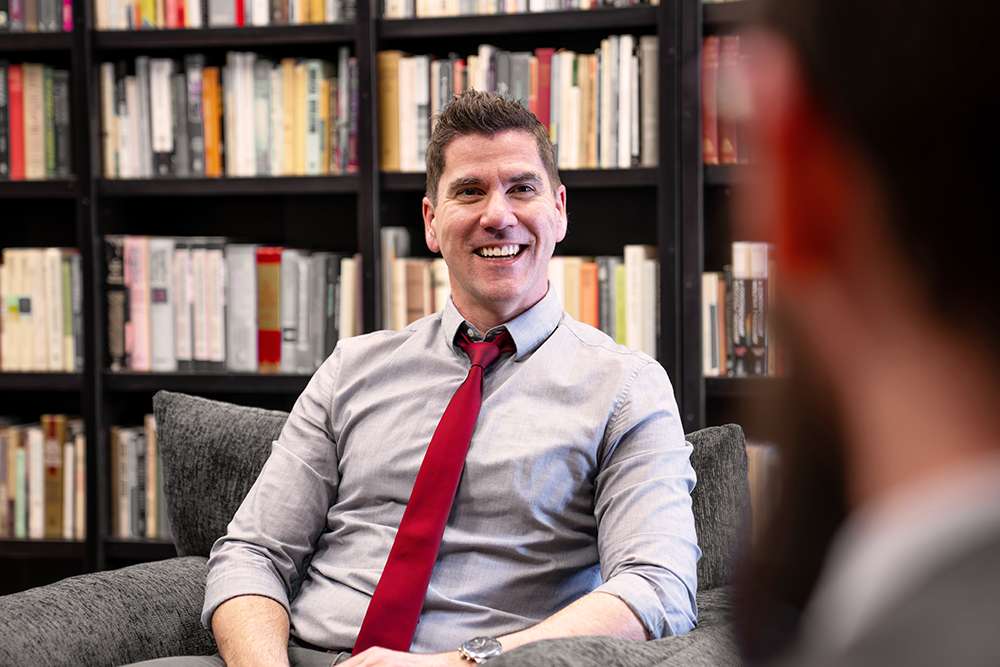
For Alex Mandura, MDiv, assistant dean at Wesley Seminary, that integration is essential.
“Seminary education isn’t only about what students know,” Mandura says. “It’s about who they are becoming as they walk with people through the realities of life.”
That “becoming” often happens in the tension between confidence and uncertainty. Students quickly discover that real ministry rarely presents clean categories or clear answers. Questions raised in the classroom return in more complex forms in hospital rooms, counseling conversations, and moments of crisis. In those spaces, seminarians learn to depend less on having the right words and more on being faithfully present.
"SEMINARY EDUCATION ISN’T ONLY ABOUT WHAT STUDENTS KNOW,” MANDURA SAYS. “IT’S ABOUT WHO THEY ARE BECOMING AS THEY WALK WITH PEOPLE THROUGH THE REALITIES OF LIFE."
ALEX MANDURA
Assistant Dean of Wesley Seminary
For Sabrina Slimmer, a Wesley Seminary student, that formation is unfolding in real time.
When she first entered ministry, Slimmer approached it with the mindset of a job to be done well. Over time, she has come to see pastoral leadership as something deeper. It requires attentiveness to people, sensitivity to the Holy Spirit, and the wisdom to recognize that faithfulness includes both service and healthy boundaries.
Her field placement has stretched her in quiet but meaningful ways. Teaching and preaching to children has forced her to slow down, simplify, and communicate with clarity. Explaining Scripture to young minds has deepened her own understanding, reminding her that truth must be lived before it can be taught.
But the most significant moments have come in seasons of suffering.
Recently, Slimmer walked alongside a family whose 11-year-old daughter was dying from a brain tumor. In that space, theological concepts about suffering, hope, and God’s presence were no longer theoretical. They were immediate and deeply personal.
“There wasn’t anything I could say to fix it,” she reflects. “But I could be there.”
What she witnessed in that family reshaped her understanding of faith. Even as their daughter’s condition worsened, their trust in God did not collapse. Their grief was real, but so was their hope. They held onto Christ in a way that no classroom could fully teach.
Moments like these form pastors in ways lectures cannot. They expose the limits of knowledge while deepening dependence on God. They teach seminarians to listen more carefully, to speak more humbly, and to trust that God is at work even when answers are not clear.
Slimmer sees this as central to the Wesleyan vision of formation.
“I’m not just studying something God did in the past,” she says. “I’m stepping into what He is doing right now. I both receive and share the grace of Christ.”
At Wesley Seminary, that movement from study to practice is not an addition to education. It is the heart of it. Field education invites students to carry theology into the complexities of real life, where faith is tested, refined, and made visible.
In time, seminarians come to understand something essential about ministry: before pastors can faithfully shepherd others, Jesus patiently forms the shepherd.
654
students enrolled in Wesley Seminary in 2025*
43
states represented by Seminary students*
17
countries represented by Seminary students*
*Stats provided by the IWU Department of Institutional Academic Research (a division of University Academic Affairs), pulling from Fall 2025 data