 M.S. Athletic Training Degree
Next Start |
M.S. Athletic Training Degree
Next Start |
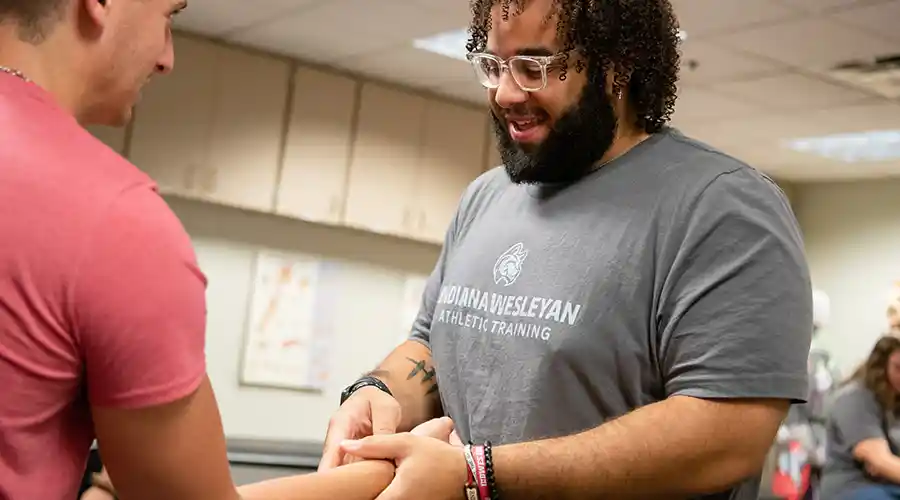
The Master of Science in Athletic Training (MSAT) degree is a 63-hour, professional athletic training degree which provides graduate students with the knowledge, values, skills, and clinical education necessary to successfully practice as certified athletic trainers. Graduates of this program will be prepared to successfully pass the Board of Certification Inc. (BOC) certification examination.
The program is designed for students who have completed an undergraduate degree but are seeking entry into the athletic training profession through a graduate program that is accredited by the Commission on Accreditation of Athletic Training Education (CAATE). The IWU MSAT program is accredited through the 2027-2028 academic year. This program is not intended for students who already have an undergraduate athletic training degree from a CAATE accredited institution or are currently eligible for the BOC certification examination.
The mission of the MSAT at Indiana Wesleyan University is to offer high-quality, evidence-based educational opportunities that help students grow intellectually, professionally, and personally within a nationally accredited curriculum in athletic training, serving the healthcare needs of Indiana and beyond.
To achieve the mission of both Indiana Wesleyan University and the MSAT, we strive to provide:
A Christ-centered learning environment that nurtures and develops professional behaviors aligned with the values of excellence, caring, honesty, and respect. These values are consistent with the Code of Ethics by the National Athletic Trainers’ Association and the Standards of Professional Practice from the Board of Certification, Inc.
A comprehensive, student-focused curriculum that covers the full scope of athletic training. This curriculum builds on students' liberal arts and science foundation, deepens their understanding of athletic healthcare issues, and prepares them to engage with and serve a diverse patient population.
A variety of didactic, laboratory, and clinical experiences that expose students to a wide range of traditional and emerging healthcare and human service delivery models.
In the MSAT program at Indiana Wesleyan University, you’ll learn:
By completing the MSAT program, you’ll be well-prepared to meet healthcare needs in Indiana and beyond, making a meaningful impact in athletic training.
IWU has provided education for more than 100 years.
Faith-integrated curriculum and a commitment to changing the world.
Center for Student Success for counseling, tutoring, and more!
The curriculum for this Master of Athletic Training covers:

These courses contain the program-specific knowledge. Upon completion, you should have the tools to conquer your new career with confidence. For a full list of courses and prerequisites required to complete your degree, please visit the course catalog. Click on a course below to view the description.
ATR-510,ATR-501,ATR-515,ATR-520,ATR-520L,ATR-502,ATR-521,ATR-521L,ATR-525,ATR-525L,ATR-516,ATR-526,ATR-530,ATR-548,ATR-503,ATR-535,ATR-535L,ATR-531,ATR-545,ATR-545L,ATR-504,ATR-540,ATR-549,ATR-517,ATR-577

$716 / Credit Hour
Financial aid is available in the form of grants, loans, scholarships, veterans’ benefits, and employer reimbursement.
Students must have completed the following courses with a grade of B or better from a regionally accredited college or university to be considered for the MSAT program. These courses provide a foundation for success in professional level graduate work in the MSAT program. The MSAT Program Director will make the final decision as to the compatibility of each course to meet curricular standards.
June 15th is the deadline for all application materials.
IWU’s MSAT combines classroom instruction, laboratory learning, clinical education, faculty mentorship, and evidence-based practice.
The program provides a variety of didactic, laboratory, and clinical experiences designed to expose students to traditional and emerging healthcare and human service settings. Students also develop relationships with faculty and professional mentors who can provide guidance as they transition into the athletic training profession.
IWU’s Master of Science in Athletic Training prepares graduates to become certified athletic trainers.
Athletic trainers may work in high schools, colleges and universities, professional and amateur sports, hospitals and clinics, corporate and industrial settings, performing arts organizations, and military or law enforcement environments.
The 63-credit MSAT curriculum provides the knowledge, clinical skills, professional values, and hands-on education needed for entry-level athletic training practice.
Students develop skills in evidence-based practice, injury prevention, evaluation, treatment, rehabilitation, interdisciplinary collaboration, and patient care. The curriculum is designed to prepare graduates for the Board of Certification (BOC) examination and professional practice as certified athletic trainers.
Clinical education is an integral part of the MSAT curriculum.
Students participate in hands-on experiences that complement classroom and laboratory learning and provide exposure to a variety of healthcare and human service settings. These experiences help students apply athletic training knowledge and develop professional skills in real-world environments.
Previous coursework may be evaluated to determine whether it can satisfy specific program requirements. Transfer decisions depend on factors such as course content and applicable accreditation standards.
The evaluation process is coordinated through the Registrar’s Office and program leadership.
IWU’s MSAT combines nationally accredited athletic training education with clinical learning, evidence-based practice, faculty mentorship, and a Christ-centered approach to professional development.
The program emphasizes excellence, caring, honesty, and respect while preparing students to serve diverse patient populations in a variety of healthcare and athletic environments.
Students who are serious about learning, committed to professional growth, and prepared for the rigor of graduate-level athletic training education are well suited for the MSAT program.
Success requires consistent academic effort, engagement in clinical learning, and a willingness to develop the professional knowledge, skills, and behaviors expected of an athletic trainer.
Yes. IWU’s Master of Science in Athletic Training is accredited by the Commission on Accreditation of Athletic Training Education (CAATE).
The current program page states that the MSAT is accredited through the 2027–2028 academic year.
The MSAT curriculum is designed to prepare graduates to successfully complete the Board of Certification (BOC) examination required to become certified athletic trainers.
Students develop the knowledge, clinical skills, evidence-based decision-making abilities, and professional competencies needed for entry-level athletic training practice throughout the program.
Health and Human Performance students learn from faculty with experience across athletic training, exercise science, physical education, sport and recreation management, and related professional fields.
Mary Jacobs is an Assistant Professor and head athletic trainer with experience in outpatient rehabilitation and high school athletic training outreach. Her professional interests include athletic injury rehabilitation, biomechanics, and human movement. She is also a Certified Athletic Trainer, Certified Strength and Conditioning Specialist, and Certified Kinesio Taping Practitioner.
Dr. Nathan Reep serves as an Assistant Professor, Clinical Education Coordinator, and Athletic Trainer. His background includes athletic training in secondary school and collegiate settings, along with experience in strength and conditioning and clinical education.
Dr. Adam Thompson is Professor and Chair of the Division of Health and Human Performance and previously served as Director of IWU’s Athletic Training Program. His experience includes clinical care, sports medicine, and work with student-athletes, and his research interests include chronic stress and burnout in healthcare, manual therapy, and sports medicine.
Students have access to university resources that support academic progress and overall well-being, including academic advising, career support, health services, technology assistance, and other student support resources.
Health and Human Performance students also receive guidance from faculty and academic advisors who can help answer questions and support their progress throughout their program.
Health and Human Performance students receive guidance from faculty advisors and other professionals throughout their program.
Regular interaction with faculty and professional mentors can help students develop professionally, explore career goals, build relationships within their field, and prepare for the transition from college into professional or graduate opportunities.
Christian faith is integrated into the learning environment across Health and Human Performance programs.
Faculty seek to connect faith and learning while helping students consider how their Christian worldview can inform professional practice, service, relationships, and their approach to their chosen field.