

The monitor’s data would not make the decision for her. Aubrey Monson, assistant professor of nursing in the Division of Pre-Licensure Nursing at IWU-Marion, has worked as a nurse-midwife at various Midwest locations since 2020. Earlier in her practice, she cared for a laboring patient whose unborn child was in trouble. Over the course of an hour, the baby’s heart rate became what clinicians call non-reassuring: category two on a three-point scale, the middle ground that leaves room for interpretation. Intervention after intervention failed.
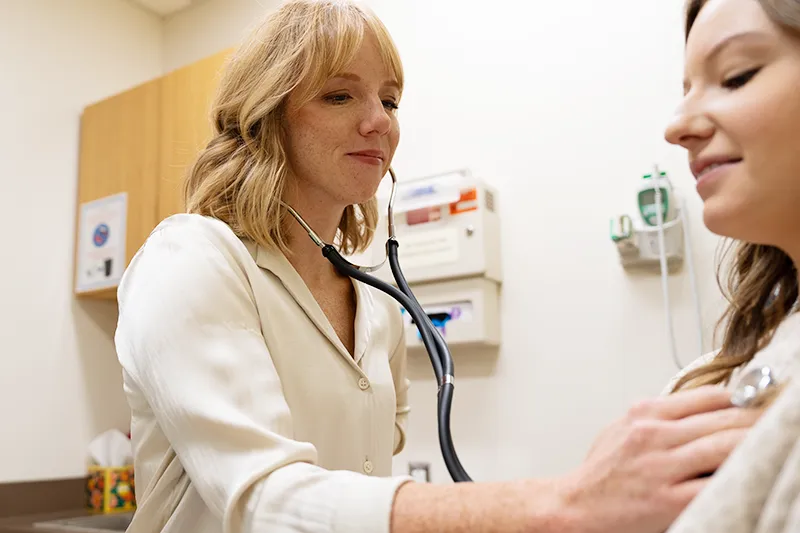
Protocol offered two roads: an urgent cesarean, delivering the baby within an hour, or an even more emergent cesarean, within 30 minutes. The clinical findings could justify either decision. “Two patients could have similar fetal heart rate patterns, but the circumstances might call for different responses,” Monson said. “Someone else may have said, ‘Do an urgent C-section.’ But I felt the Holy Spirit prompting me: ‘You need to get this baby out right now.’”
That is Christian imagination lived out through faith and service. It does not simply look ahead to the world Christ will one day set right. It recognizes Him at work in the present, shaping how people understand their calling, respond to uncertainty, and serve others with wisdom and compassion.
Acting on it cost Monson something. As the nurse midwife managing the patient’s labor, she could recommend an immediate delivery, but the cesarean required the involvement of the attending OB-GYN. Advocating, she admitted, is one of the weaker parts of her practice, especially when she is up against a physician with more training and experience. When Monson discussed the case with the OB-GYN and recommended the cesarean happen now, the physician questioned whether it was necessary. Monson held her ground, and the physician listened and agreed.
The cesarean was performed immediately, and, as Monson had sensed, the newborn needed significant resuscitation. Monson’s role in the cesarean was mostly to support the mother, whom she regarded not as a case but as a child of God and a fellow mother. Monson stayed beside her and prayed until the baby was breathing on its own.
Afterward, she second-guessed herself: had she made the right decision? The OB-GYN’s response offered reassurance: “I wouldn’t have done an emergent cesarean in that situation. But the fact that you suggested it may have saved that baby’s life.” There was no way to know what might have happened had she chosen differently, but the experience helped replace doubt with a growing confidence in her clinical judgment and her ability to discern the Holy Spirit’s guidance. “It increased my courage and my confidence, not just in myself, but in my ability to interact with the Holy Spirit in my practice.”
For Monson, learning to recognize God’s guidance in clinical decisions has been an ongoing practice, not something confined to that emergency. She has learned to expect God’s interest in every part of her work, not just in devotions. Before a difficult appointment, she prays at the door: “Come into this room with me. Give me guidance on what to say, what to do, and what questions to ask.” What follows is less an audible voice, she said, than an instinct she has learned to trust.
Celebrating
51
years of IWU nursing graduates.
Source: Institutional Research, September 2026
Ranked
#4
nationally among faith-based programs—RN-to-BSN program.
Source: RegisteredNursing.org, November 2025
3,523
nursing graduates from IWU since 1975.
Source: Institutional Research, September 2026
100%
of IWU’s pre-licensure nursing graduates passed the NCLEX-RN on the first attempt in the most recent state-reported period.
Source: Pre-Licensure Nursing Program, August 2026
10
different nursing programs offered by IWU.
Source: Institutional Research, September 2026
Her students inherit that understanding of faith and practice. Monson wants them to approach even routine clinical encounters as opportunities to participate in God’s work. In class, a lesson on fetal circulation invites students to marvel at the Creator. At the bedside, recognizing patients as people God loves deeply calls for attention to both their physical needs and the fears, uncertainties, and circumstances affecting their lives. A Christian’s renewed perspective brings those together, pairing clinical competence with spiritual attentiveness.
“It’s more than just a job,” Monson said. “It’s actually a calling from God, because we get to serve people, the least of these included.” For Monson, that calling means remaining attentive to God’s guidance even when the right decision is uncertain, and having the courage to act when conviction demands it. It is what she hopes her students will carry into their own practice: a faith that does not stand apart from their professional knowledge but frames how they use it.
The monitor can provide the clinical data, but it cannot tell a nurse what the moment means or what the right response requires. Monson wants her students to see the patient, the circumstances, and their own calling in light of God’s truth, and then bring that discernment to the decision before them.
