

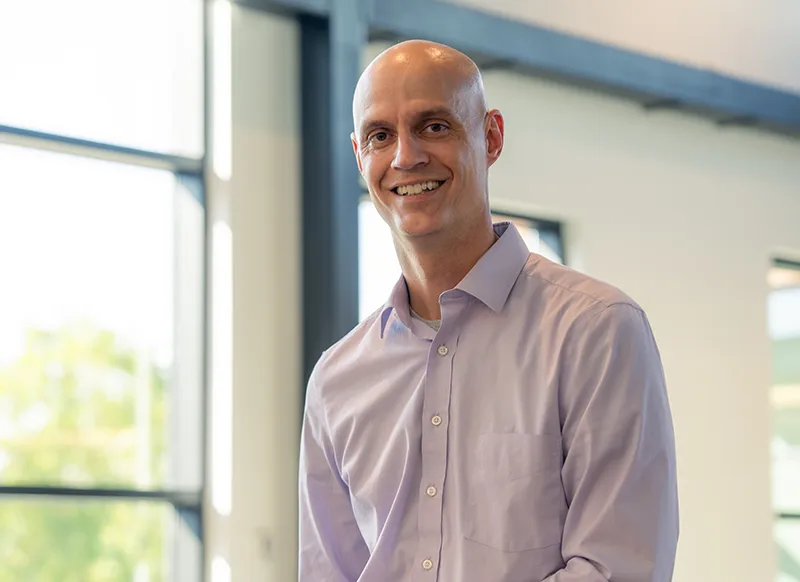
The newest tutor in Becky Wakeman’s math education course is an AI bot designed not to give students answers, but to keep them thinking. Wakeman, associate professor and chair of the Division of Mathematics, Engineering, and Computer Science at IWU-Marion, built the exam-review tool herself. When students get stuck, the bot responds with questions and prompts that help them identify what they know, work through the problem, and reach the answer themselves.
Behind Wakeman’s tool is a question larger than what AI is capable of doing: How can its potential be put to work in ways that advance Christian education and service?
“I’m looking at who I want my students to become,” Wakeman said, “and that includes honing their critical thinking and problem-solving skills.”
Christian imagination brings biblical truth to the possibilities emerging technologies like AI make available. Rather than evaluating innovation solely in terms of technical capability, it asks how those advances can serve purposes consistent with God’s intentions for humanity. In Wakeman’s classroom, that means using the technology not simply to produce answers, but to deepen learning by helping students work through problems themselves.
“The goal is to learn, not necessarily to get it right on the first try,” Wakeman said.
Engage or Be Shaped
“Our students are going to live and work in a world shaped by AI,” said Tod Dalberg, executive vice president and chief innovation and strategy officer at IWU. “Whether we choose as an institution to engage with AI is not really the question. I think we have to. Our responsibility is not merely to teach students how to operate it, but how to form it, to bring ethical and moral conversation into it with strong Christian character.”
Ignoring AI altogether would mean surrendering opportunities to influence how it develops and is used. The Christian perspective offers another approach: engage the technology, bringing biblical wisdom to its development and directing its capabilities toward purposes that honor God. Human intellect and creativity are gifts from God, and believers have an opportunity to put those gifts to work in advancing education, ministry, and service. Rather than simply responding to the changes AI brings, they can help determine how it is used.
“AI is neither inherently good nor inherently bad, but it is consequential,” Dalberg said. “Our students’ professions, their communities, their churches, and their relationships are all being impacted by it.”
6
AI or AI-integrated degree programs in the DeVoe School of Business, Technology, and Leadership.
1,203
IWU-N&G students enrolled in AI-integrated programs during the 2025–26 academic year.
70
students have already graduated from IWU’s new AI-integrated programs as of July 2026.
Source: IWU-N&G, August 2026
What Purpose Does It Serve?
That commitment to responsible engagement led IWU to establish the Center for Applied Ethics and AI through the DeVoe School of Business, Technology, and Leadership. The Center, said Clark Cully, Ph.D., technology division chair at IWU-N&G, helps leaders in higher education, industry, communities, and churches consider both the opportunities and challenges of AI.

“We want the Center to educate people [about AI] and to think about the nature of the challenges before them, then determine if it is a problem for which AI and its massive statistical power is the right tool for the job, or if it’s the type of problem where our human context, our relatedness, our embodiment, has an important contribution to the outcome,” Cully said.
“The Christian call is to discern well that which is in front of us,” said Steven Keil, Ph.D., the Center’s founding director and director of Tech Programs and Ethical AI Initiatives at IWU-N&G. “This is true for a variety of tools and contexts in our lives, and it isn’t any different with AI. Our call is to discern, not to embrace or reject it uncritically.”
Jesus’ commands to love God and love our neighbors provide the foundation for evaluating how innovative tools should be used. Those commitments help Christians identify applications that strengthen communities, expand opportunities for ministry, and address human needs. New capabilities and greater efficiency have value when they help people serve God and others.
Measured against those principles, AI offers considerable promise. It can improve communication, create visual resources, and translate materials, helping the church connect with communities that have limited access to the Gospel. In education, it can explain concepts and assess students’ understanding, while its ability to analyze data helps identify important trends. Automating routine tasks can also give people more time for critical thinking, meaningful relationships, coaching, and mentoring.
Wesley Seminary is exploring such benefits through its Vocational, Integrated, and Adaptive (VIA) Journeys initiative, launched with a $10 million grant from Lilly Endowment Inc. Working with partner organizations, VIA is designed to use AI to process a ministry leader’s context, prior experiences, advisor guidance, and available resources to identify relevant opportunities for growth through human mentorship. The involvement of various partner organizations in the effort reflects a shared commitment to considering how emerging technologies might support theological education and ministry.
Purposeful Use
Wakeman’s exam-review bot illustrates how technological advances can strengthen learning when they are designed to support rather than replace students’ thinking. Keil emphasized the same principle: AI can assist students without eliminating the productive struggle that builds understanding. Applying that approach more broadly also means considering AI’s energy and resource demands and avoiding excessive dependence on technology.
Cully cautions against another risk: mistaking AI’s apparent knowledge and capabilities for something greater than they are. “AI is a simulacrum,” Cully said, using a term for a copy that imitates something real. “It appeals to our God-given desire to engage with something that feels transcendent. For this reason, we need to be careful, intentional, and purposeful in our engagement with AI.”
Intentional Stewards
For Dalberg, the opportunity is to put those convictions into practice across the university. Emerging innovations offer new ways to improve efficiency, expand capacity, and advance IWU’s work, but those benefits must be considered in light of the university’s mission: being a Christ-centered academic community committed to changing the world by developing students in character, scholarship, and leadership. The measure of success is not how extensively IWU adopts emerging technology, but how effectively it uses it to advance education, scholarship, leadership, and service.
“We do not want to become the university that uses the most AI,” he said. “That would be a mistake on our part. What we should become is a university that demonstrates wise, faithful, critical, creative, and distinct Christian engagement with AI.”
A Gospel-inspired perspective invites believers to consider how AI’s expanding capabilities can be directed toward purposes grounded in biblical truth. Wakeman’s bot offers a small but concrete example: rather than simply giving students an answer, it helps them engage more deeply with what they are learning. Across IWU, that same commitment can guide the use of this technology to strengthen education, expand access, support ministry, and serve others. The goal is not necessarily more AI, but wiser use of it. In that role, these tools can extend human work without replacing the judgment, relationships, and responsibility that give that work meaning.
The AI3 Summit was convened by the DeVoe School of Business, Technology, and Leadership in March 2026:
- The successful event brought together more than 400 participants from the Midwest region.
- 17 universities and multiple industries were represented.
Source: Center for Applied Ethics and AI, August 2026
