

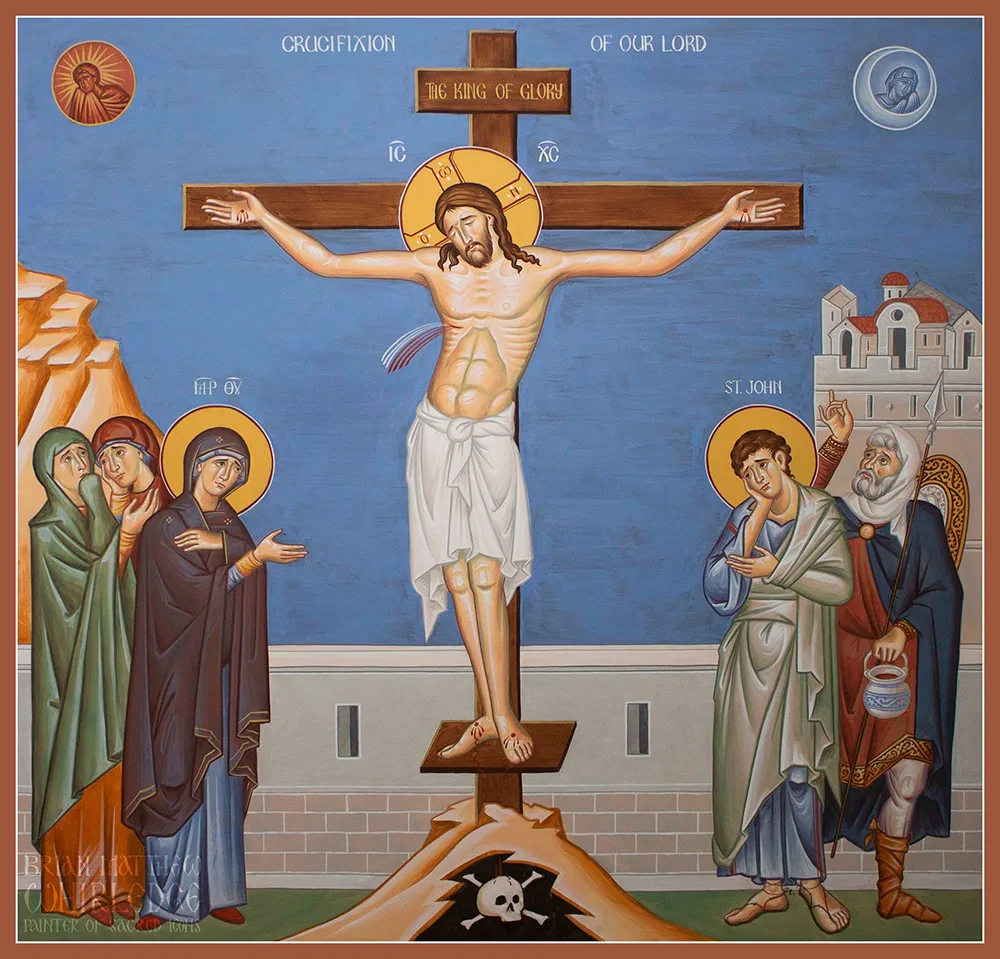
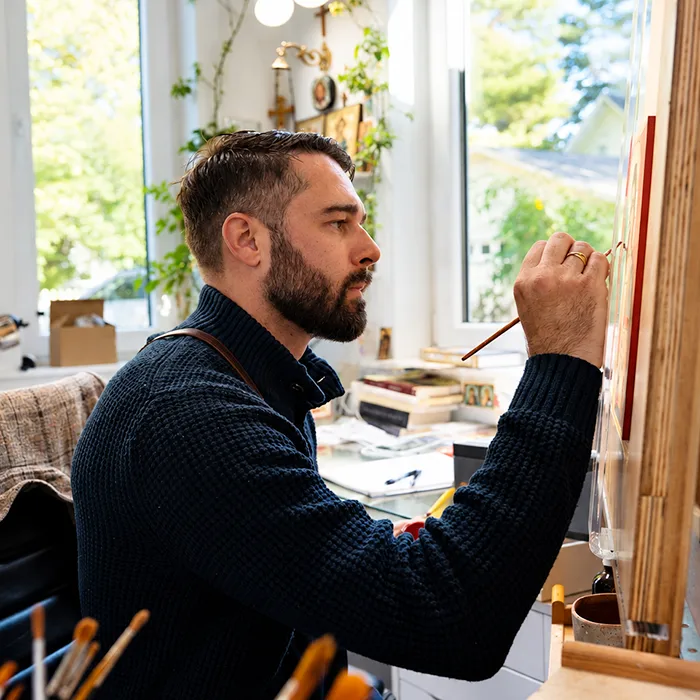
He mixes the pigment of finely crushed minerals into an egg yolk medium. On a wooden panel sealed with rabbit skin glue and chalk, he paints an image of Christ hanging from a cross, divine suffering writ upon His face. He applies a final varnish and steps back. What painter Brian Whirledge ’07 sees in the finished product is matter transfigured into the image of God.
The IWU-Marion John Wesley Honors College graduate has built a career as a religious artist, creating sacred images that serve as devotions for churches and homes across the country.
“The painting itself is a visual prayer,” he said. The suffering of Christ takes visible form through Whirledge’s choices of color, expression, and gesture. The image does not minimize that suffering or ask the viewer to look away. But the cross also reveals, Whirledge said, that what appears to be defeat is not the whole story. Christ’s death was real, yet through it, God was accomplishing something greater: redemption.
Through such expression, the arts cultivate Christian imagination by helping people understand present reality in light of what God is doing beyond what is immediately apparent. Art can hold what is visible alongside a deeper truth about God’s purposes, drawing attention to meaning, beauty, and truths about God and His creation that might otherwise go unnoticed or be difficult to express in words.
Making the Unseen Visible
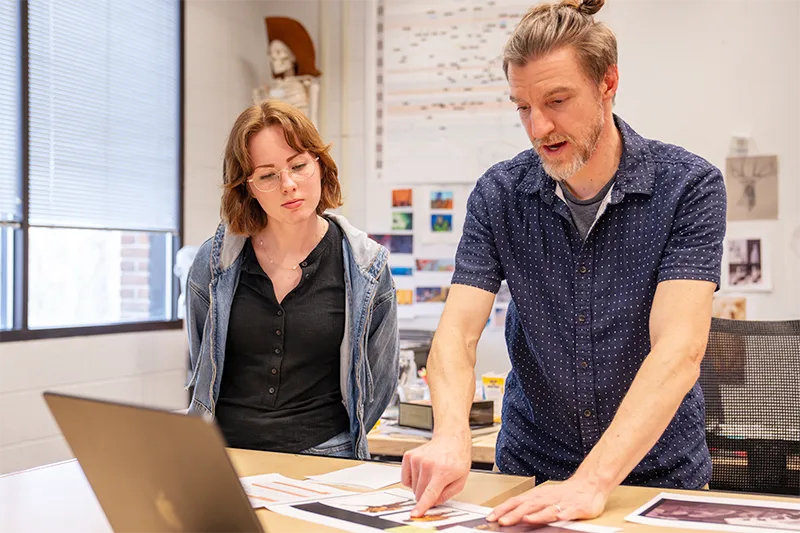
The arts are not peripheral to Christian education because, as Keith Lowe, assistant professor of illustration at IWU-Marion, explains, they respond to how we see and understand the world. They are one of its richest expressions, equipping artists to help others view the world through renewed eyes.
“How do you depict the Holy Spirit, for example?” His brow furrowed at the problem, his eyes alight with curiosity. The Hebrew word for spirit, רוח (ru’ach), also carries the concepts of breath, air, and wind. “You use symbols: color, shape, line, some kind of visual language that quietly tells the reader who the Spirit is.”
To paint the third Person of the Trinity, Lowe had to look at ordinary images until they could carry something larger. These images include the dove that descended on Jesus at His baptism and the golden spiral that recurs throughout creation, from sunflowers to snail shells to storm cells. Though subtle, such imagery can direct a viewer toward truths and understanding that language cannot fully capture.
Scripture offers an early example of this relationship between craftsmanship and divine imagery. When God commanded the tabernacle be made, He showed Moses a “pattern” on the mountain, and the New Testament names what the finished sanctuary was: “a copy and shadow of what is in heaven” (Hebrews 8:5). Someone had to build that copy out of earthly materials. In one of Scripture’s earliest accounts of being filled with the Spirit of God, an artist was entrusted with making visible what human eyes could not otherwise see. Bezalel, neither a prophet nor a king, was a craftsman equipped to work in gold, silver, stone, and wood, helping create a dwelling place that reflected God’s heavenly design (Exodus 31:1–5).
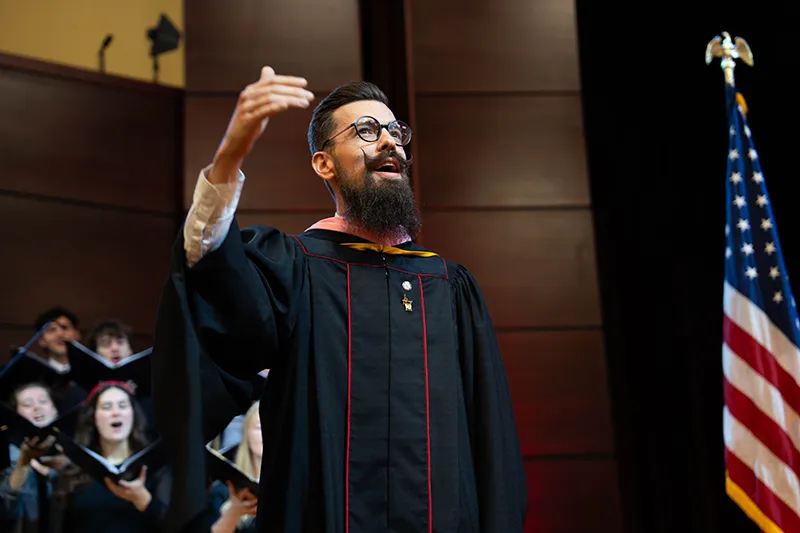
Bezalel’s story also shows that artistic skill has a purpose beyond the work itself. Artistic ability comes from God and, in Christian practice, should ultimately be directed back toward Him. For Davy Chinn, assistant professor of music at IWU-Marion, that connection between Creator and creator gives artistic work its true purpose. “If we as Christians say it starts with God giving us the power and ability to do anything, then the end has to come back to the beginning,” he said. “God created me to do a thing, and I’m doing that thing to glorify God. This gives the doing eternal purpose.”
Tammie Huntington, professor of applied voice at IWU-Marion, tells her students something similar in the vocal studio. Their task is not simply to “sound good,” but to use the particular voice God has given them as an offering of worship back to Him.
40
students in IWU-Marion’s audition-based Chorale, which performs sacred and other choral music.
Source: Division of Music + Theatre, September 2026
30
voices in Cantate, IWU-Marion’s women’s chorus.
Source: Division of Music + Theatre, September 2026
40
dedicated studio spaces for IWU-Marion students studying art and design.
Source: Division of Art + Design, September 2026
Art That Forms Us
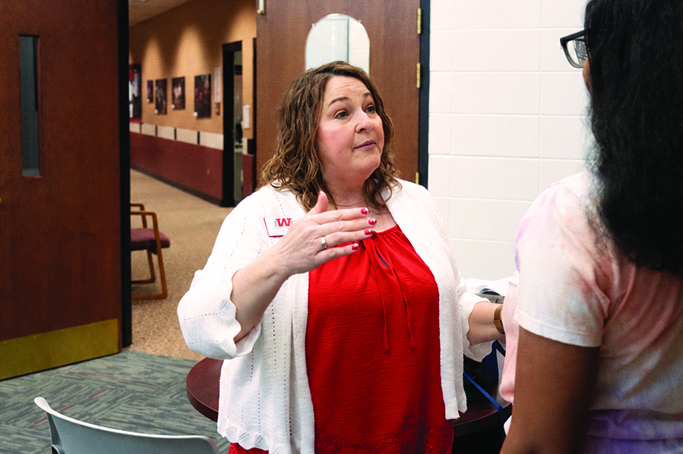
For Huntington, that offering can shape the artist as much as the audience. She tells students that the studio is a “safe space to fail,” because mistakes are where growth happens, and reminds them that every trip to the practice room is “an act of worship.” When stage fright hits, she asks them to imagine not a judging audience but the throne of God and a Father who delights in their adoration.
Music can also help people absorb words more deeply. Huntington has watched students who feel “blocked” in prayer begin to weep while singing a worship song. She calls melody, rhythm, and harmony the “glue” that helps lyrics stay with people after the music stops. When those lyrics are rooted in Scripture, the song can help believers remember and meditate on biblical truth long after they leave the room.
Chinn makes a related point: music can help people grasp truths about God that are difficult to express in words alone. A doctrinal statement can explain what Christians believe, he said, but music can help those truths take hold more deeply. Because what people dwell on influences how they understand the world and live within it, Chinn believes Christian education should help students create and engage art that directs their attention toward Jesus.
Beyond Words
What Huntington and Chinn describe through music, Lowe and Whirledge pursue through visual art. Lowe uses color, shape, and symbol to point toward truths that language cannot fully capture; Whirledge works with crushed minerals, egg yolk, and wooden panels to make images of Christ through disciplined craft.
The materials change from one art form to another—breath and vibration, pigment and wood, words, color, shape, and line—but the purpose is similar: to arrange what has been given so others might notice something true that they had not recognized before.
Whirledge calls his work “the Gospel in color.” His visual prayer invites viewers to consider Christ and the world through the same lens: Christ’s death appeared to be defeat, but the resurrection revealed it was not the end. What seems marred or final can be understood in light of what God is making new.
Musical Theatre Degree
Planned for Fall 2027
IWU plans to introduce a Bachelor of Arts in Musical Theatre in fall 2027, pending required academic and accreditation approvals. Building on the collaboration between music and theatre established through the division’s unification in 2023, the proposed program will bring together performance, music, and storytelling in a Christ-centered learning environment. The degree represents a long-standing aspiration to expand opportunities for students pursuing careers in the performing arts.
