

Halfway through her spring research project, Audra Flanary ’29 was staring at a mountain of unprocessed data. The IWU-Marion sophomore had spent months studying small fruit physiology with Jacob Buck, assistant professor of biology, through the Hodson Research Institute (HRI), hoping for a clear-cut solution for sustainable crop production. Instead, she had numbers without a conclusion.
For Christians, science is one way of paying disciplined attention to what God has created. Christian imagination does not change how science is practiced; it gives that work a larger purpose. Because God’s creation is good, it is worth studying carefully, even when, as Flanary found, answers come slowly. Discovery can deepen wonder and help researchers understand nature and its Creator more fully. As knowledge grows, so does responsibility: How can it deepen understanding, guide care, or help restore what is broken?
Knowing the Creator
For Flanary, her research standstill took on new meaning. The data stopped being a wall and offered another way to know God better.
“The way I look at my relationship with God is the same way I have started to view research,” Flanary said. “The more intimately you know something, the better you understand its character.”
Flanary plans to carry that understanding beyond her research long after graduation. “Whether it’s looking through a microscope, performing a dissection, or listening to a lecture, I now find myself searching for instances where I see the awe and wonder of God’s creative abilities.”
Later that summer, after presenting alongside fellow HRI students and faculty at the 2026 American Society for Horticultural Science Conference in Dallas, Flanary put the connection more simply: “I realized I have grown a respect for research because it is a chance to look deeply into creation while growing closer to God.”
40+
STEM academic pathways across majors, minors, and pre-health concentrations at IWU-Marion.
Source: School of Science, Technology, Engineering and Math, September 2026
300+
IWU-Marion students have conducted hands-on scientific research through the Hodson Research Institute since 2011.
Source: Hodson Research Institute, September 2026
255
IWU-Marion School of Science, Technology, Engineering and Math (STEM) undergraduate students enrolled for the 2026–27 academic year.
Source: Institutional Research, September 2026
119%
net growth in IWU-Marion’s Division of Mathematics, Engineering, and Computer Science undergraduate enrollment since 2020.
Source: Institutional Research, September 2026
Wonder in the Unseen
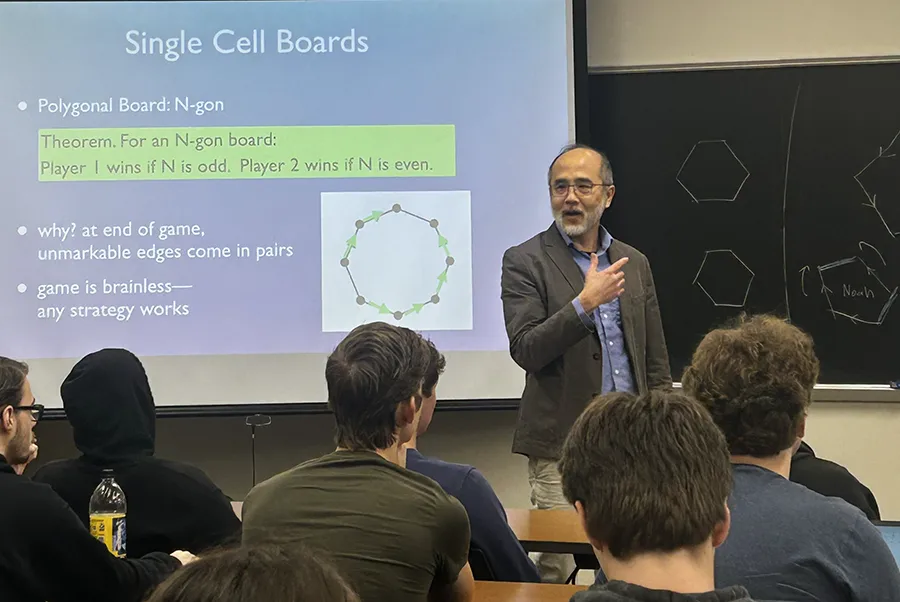
Christian mathematician and author Francis Su, Ph.D., described a similar posture when he visited IWU-Marion as a guest lecturer in March 2026. Mathematics, he explained, trains people to recognize realities they cannot see directly.
“We hold to this idea that there are mathematical laws you cannot see that have direct influence on the universe, and that’s similar in a life of faith,” said Su, the Benediktsson-Karwa Professor of Mathematics at Harvey Mudd College. “God, whom we do not see, has power to shape the moral universe.”
What Knowledge Is For
The wonder Flanary finds in studying creation echoes in Su’s understanding of the unseen laws that govern it. But scientific knowledge does not always stay in the laboratory or classroom. Engineers put it to work in ways that affect people’s lives. For David Che, Ph.D., IWU-Marion’s engineering program director and professor of mechanical engineering, understanding how something works is only the beginning. What matters just as much is how that knowledge is used.
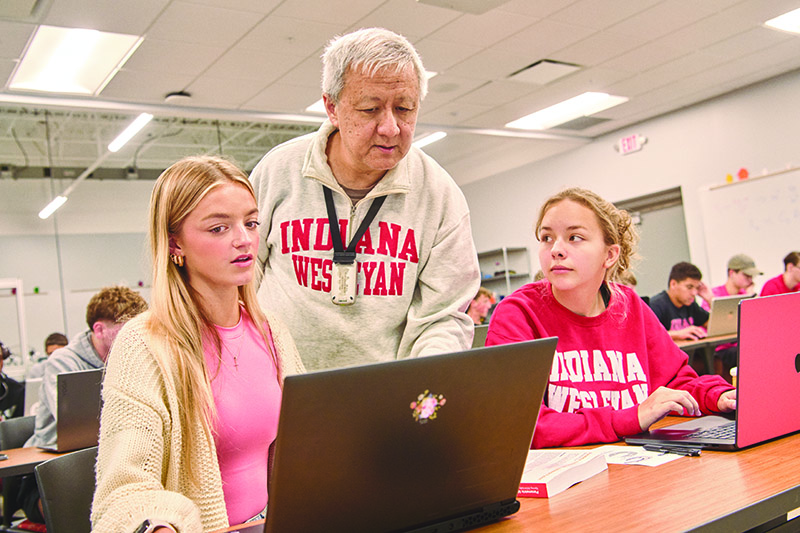
“For a Christian engineer, solving a problem means more than making something work. We have to ask what is broken, who is affected by it, and how what we know and create can help restore something that is not as it should be,” Che said.
Che brings that responsibility into the classroom, teaching students that engineering ethics require them to hold “paramount the safety, health, and welfare of the public.” Technical ability, in other words, is accountable to the people and communities it affects.
“God is a problem solver, and we teach our students to be problem solvers,” Che said. “God is also a designer. As image bearers, we want to exercise God-given creativity and talent.”
Flanary’s perseverance, Su’s wonder at the universe’s unseen order, and Che’s concern for public welfare reveal how a redeemed perspective informs scientific inquiry. It begins with the conviction that God’s creation is worth understanding, even when answers come slowly. And it asks what that knowledge can do for others in light of Christ’s promise to restore what is broken. Discovery, then, is not simply about finding answers. It is also about using them to serve.
