

The Triangle speaks with IWU President Jon S. Kulaga, Ph.D., about Christian imagination, artificial intelligence (AI), Higher Education 4.0, and the future of a distinctly Christian university.
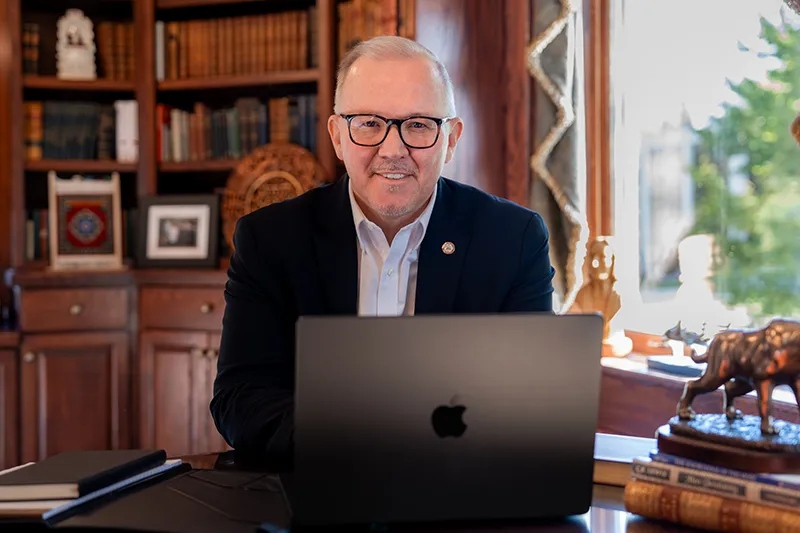
THE TRIANGLE: Dr. Kulaga, technology is changing almost every aspect of our lives. You’ve suggested that AI represents something more significant than just another technological advancement. What makes this moment different?
DR. KULAGA: I think it helps to look at how education has changed over time. I describe that progression as Higher Education 4.0 because it reflects the four major shifts that have shaped higher education.
The first shift is where the professor stood at a chalkboard and shared what he knew. The chalkboard eventually became a whiteboard, and then we introduced other classroom technologies. But the fundamental model remained the same: the professor possessed the information and expertise, and students came to receive it.
The second shift was the growth of adult education, which brought learning to students where they lived and expanded opportunities beyond traditional stages of life.
The third shift came with the internet, which made education more accessible beyond the physical classroom.
Now we’re in the fourth. AI gives people access not only to educational tools and resources but also to a level of expertise and personalized guidance.
That raises a fundamental question for every university: What is a university for when educational tools, resources, expertise, and guidance are available almost anywhere? For a Christian university, there’s an even deeper question: What can we offer that technology cannot?
Christian Imagination Defined
THE TRIANGLE: And your answer to that question begins with something you call Christian imagination. What do you mean by that?
DR. KULAGA: Christian imagination is central to how we understand the purpose of a Christian university. When I talk about imagination, I’m not simply talking about creativity, artistic ability, or daydreaming. Christian imagination is the habit of understanding present reality in light of the larger story Scripture tells—from God’s good creation, through the brokenness of sin and Christ’s redeeming work, toward the restoration He has promised.
Every one of us carries an internal picture of what a good life looks like, what our work is for, whom we can trust, what we should fear, and what kind of future we hope to build. Those pictures shape our decisions, often without our even realizing it. So, the question isn’t whether we’re being formed. The question is: What is forming us?
As a Christian university, we want our students to learn to see the world through the story of Scripture and the hope of the Gospel. In other words, The Word of God and The Work of Christ. We want them to understand their studies, relationships, careers, and callings in light of the larger story of what God is doing in the world through Jesus Christ.
THE TRIANGLE: That sounds like something much larger than simply teaching students Bible verses or adding a Christian perspective to a particular class.
DR. KULAGA: It is. Christian faith isn’t supposed to be an isolated part of a student’s education. It should shape the way we understand everything. It gives us a framework for understanding creation, culture, scholarship, human relationships, and the work we’re called to do. It also gives us a way to confront the brokenness we see around us without surrendering to despair.
Higher Education 4.0
Higher Education 4.0 is the university rebuilt for an age when technology provides educational tools and resources, a level of expertise, and personalized guidance—centered on the work technology cannot do: forming graduates who imagine what could be and let biblical truth guide what should be.
-
1.0: The Chalkboard
Information and expertise lived with the instructor, and students came to receive them.
-
2.0: Adult Education
Education came to students where they lived and expanded learning beyond traditional stages of life.
-
3.0: The Internet
Education became widely accessible beyond the physical classroom.
-
4.0: Artificial Intelligence
People now turn to technology for educational tools and resources, a level of expertise, and personalized guidance.
Christians believe that Jesus Christ will return and make all things whole. But God’s redemptive work isn’t something that begins only in the future. Through the death and resurrection of Jesus, God has already opened the way for reconciliation, and He continues to transform lives today.
That means we can face difficult realities with more than wishful thinking. We can forgive an enemy, repair relationships, serve our neighbors, and work toward the good of our communities because we believe Christ is already at work in people and places around us.
That’s the kind of imagination we want to cultivate at IWU: the ability to see what is broken while also seeing what, through God’s redeeming work, it might become.
It’s also the focus of our Common Learning Theme led by our Center for Faith and Learning. The Common Learning Theme is a two-year initiative that brings faculty and students together around a shared idea through readings, visiting authors, performances, and other experiences.
THE TRIANGLE: How does IWU help students develop Christian imagination? Is this primarily happening in theology and Bible classes?
DR. KULAGA: Theology and Bible are certainly important, but Christian imagination should influence the whole university experience. Across every discipline, we want students to understand the world through the lens of biblical truth and consider how their knowledge and abilities can serve God’s purposes.
THE TRIANGLE: You described AI as the fourth shift in Higher Education 4.0. What does this new era require of a Christian university?
DR. KULAGA: AI gives people access to educational tools, resources, expertise, and personalized guidance. That changes the environment in which universities operate. It changes what students expect, what employers need, and how people approach learning and problem-solving.
But it also creates an opportunity. If those resources are increasingly accessible, a university must offer more than access. We need to help students develop wisdom, discernment, character, and the capacity to use what they know for the good of others. For a Christ-centered university, that means preparing students to engage new technologies without losing sight of biblical truth or the purpose for which God created them.
THE TRIANGLE: Does that mean IWU should embrace AI as fully as possible, or should a Christian university be more cautious?
DR. KULAGA: I don’t think the answer is to retreat from technological change. But neither should we embrace every new innovation simply because it is available. There’s a question I keep coming back to: Just because we can, should we?
That’s not a new question. The apostle Paul made a similar distinction in 1 Corinthians 10:23 when he wrote that not everything permissible is beneficial. Technology changes, but the need for moral discernment doesn’t.
At IWU, we’re compelled by our mission to bring a biblical ethic to our use of AI. We have to consider what can appropriately be entrusted to technology and what must remain fundamentally human because every person bears the image of God—the imago Dei.
We need to ask not only whether a technology works, but also whether it serves people, honors their dignity, and advances the purposes of a Christian education.
THE TRIANGLE: Can you give us an example of how that distinction works in practice?
DR. KULAGA: One example is us using AI to help sort prospective student and alumni contacts. It reduces routine work and frees our employees to spend more time engaging with people. That’s an important distinction. We’re not using technology simply to replace the human element. We’re using it to redeem time and create more opportunities for meaningful human interaction.
The same discernment must extend to the classroom. A professor might decide to ban AI in a particular assignment because its purpose is to develop a student’s abilities. In another setting, learning to use AI responsibly may be an essential part of professional preparation. We have to understand the purpose of the activity before deciding how technology should be used.
Ultimately, students will encounter AI beyond the classroom and throughout their careers. Our responsibility is to help them develop the judgment to use it wisely.
THE TRIANGLE: You’ve also described the university as being in the “forming and norming business.” What does that mean for the way IWU prepares students?
DR. KULAGA: I believe formation is at the heart of what a university does. We’re not simply transferring knowledge or preparing someone to perform a job. We’re in the forming and norming business while they’re here.
Consider athletics. A coach certainly wants to win, and winning matters. But if a Christian coach sees the job only in terms of winning games, that coach is missing something fundamental. We’ve been entrusted with young people during one of the most formative seasons of their lives. Every practice, team meeting, victory, defeat, and relationship can contribute to their development.
So, we need to ask a bigger question than “How do we win?” We need to ask, “What are we preparing these students for?” Whether we’re teaching in a classroom, coaching on a field, conducting research, or serving students through administrative offices, we have a role in their formation.
88%
of IWU-Marion students say IWU has strengthened their ability to make ethical decisions from a Christian worldview.
Source: IWU Marketing survey, October 2026
93%
of IWU-Marion students say at least one faculty/staff member has significantly influenced their development.
Source: IWU Marketing survey, October 2026
91%
of IWU-Marion students say their IWU experience has helped them clarify their calling or purpose.
Source: IWU Marketing survey, October 2026
THE TRIANGLE: That charge seems especially important when a university itself is navigating change. How do you balance the need to innovate with the responsibility to preserve IWU’s mission?
DR. KULAGA: We have to adapt. We cannot simply assume that the approaches that served us well in the past will be sufficient for the future.
But adaptation cannot come at the expense of the mission that gives the university its purpose.
I’ve said it this way: “If you go out of business, you can’t fulfill your mission. If you get rid of your mission because you’re trying to survive in all the wrong ways, you can’t fulfill your mission.”
THE TRIANGLE: How do Christian imagination and Higher Education 4.0 come together in that larger vision?
DR. KULAGA: I see them as complementary. Christian imagination helps us cultivate a hopeful, redemptive way of seeing the world. Higher Education 4.0 asks how we prepare students to carry that perspective into a world being reshaped by technology and other forms of change.
We want students to imagine life as God intended it to be. That means looking beyond utility, fear, or the expectations of the surrounding culture and asking what genuine human flourishing looks like.
The biblical concept of shalom is helpful here. It points toward wholeness—people living in peace with God, with their neighbors, and within themselves.
That vision can shape how our graduates approach their professions, relationships, communities, and responsibilities. It can help them discern which opportunities move us toward greater wholeness and which might move us away from it.
THE TRIANGLE: Finally, what would you say to someone who wonders whether the rapid pace of technological change threatens the distinctiveness of Christian higher education?
DR. KULAGA: I would say that technological change makes the distinctiveness of Christian higher education more important, not less.
The chalkboard eventually gave way to other tools. AI will eventually give way to something else. While we must remain willing to learn and innovate, we need to remember that the foundation of a Christian education doesn’t change.
Hebrews 13:8 reminds us that Jesus is the same yesterday and today and forever. His truth remains our foundation even as the world around us changes.
