

At IWU, Scripture has been sung, Shakespeare recast as a Norse saga, and the meaning of beauty explored by visiting thinkers. These encounters are part of IWU’s Common Learning Theme, The Christian Imagination, led by the Center for Faith and Learning across two academic years. Although the events highlighted here took place on the IWU-Marion campus, students, faculty, and staff from all three academic units—IWU-Marion, IWU-N&G, and Wesley Seminary—were invited to participate.
For Anne Greeley, D.Phil., professor of art history at IWU-Marion and co-chair of the Common Learning Theme, bringing students into conversation with art, music, literature, and other intellectual traditions is part of the theme’s purpose. “The great Christian works of the past have shaped my imagination in distinctively Christian ways, and my hope as a Christian educator is that my students will be similarly shaped through their own engagement with that tradition.”
Despite their variety, these experiences shared a common purpose: to give participants new perspectives by which to understand how God, through Christ’s work, sees them, their neighbors, and the world. Through concerts, plays, exhibitions, lectures, and reading groups, participants encountered ideas, stories, and artistic expressions that invited them to think more deeply about their learning, creativity, and relationship with God.
Christian Imagination by the Numbers—IWU-Marion
Summer 2025 through Fall 2026
31
exhibitions, performances, readings, and lectures.
9
visits from outside scholars.
8
featured books and texts explored.
Source: The Center for Faith and Learning, August 2026
Voice and Song
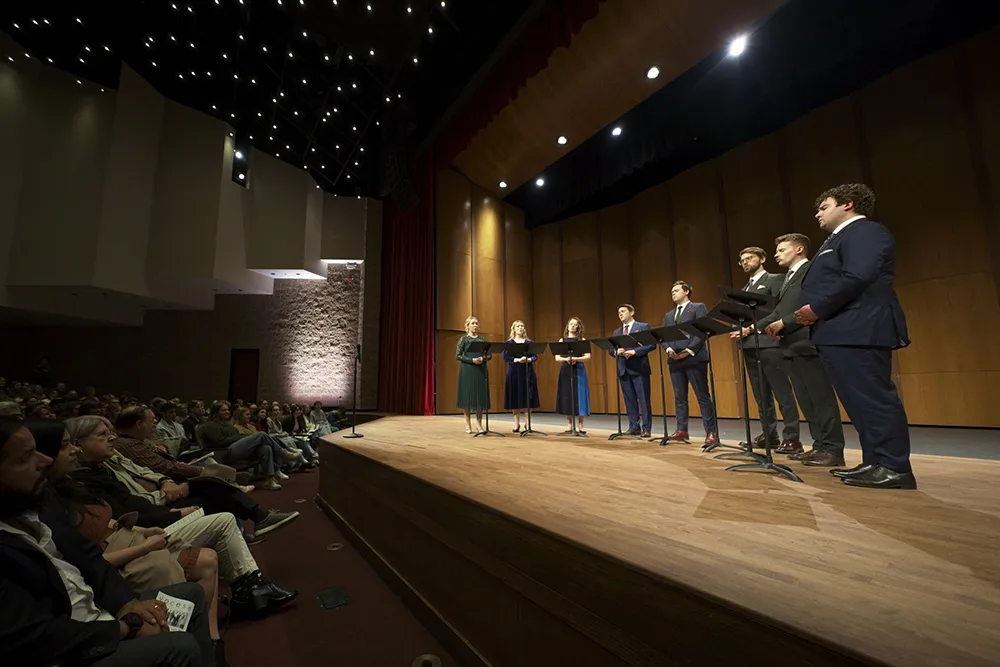
October 2025 brought Grammy-nominated British vocal ensemble VOCES8 to campus for workshops and a concert with the IWU Chorale. Its wide-ranging repertoire invited audiences into unfamiliar musical expressions, while the collaboration gave students an opportunity to learn alongside professional performers.
In December, the IWU Chorale and Orchestra performed George Frideric Handel’s Messiah. Drawing on biblical prophecy, the Gospels, and Revelation, the oratorio recounts Christ’s life, death, and resurrection while anticipating His return. Author Charles King’s campus visit and advance reading groups on his book Every Valley, which explores the lives and turbulent times behind the creation of Handel’s Messiah, provided historical context for the performance. For student performers, singing those texts connected the longing before Christ’s birth with the Church’s hope for His return.
Stories Reconsidered
The IWU Theatre Guild’s November 2025 production of Shakespeare’s The Tempest moved the action into a Norse world. Under the direction of Steve Wood, Ph.D., associate professor of theatre at IWU-Marion, Ariel, a spirit in the play, became two characters inspired by Odin’s ravens, representing thought and memory. The staging, student-designed elements, and original music offered new ways to consider power, betrayal, forgiveness, and redemption without discarding the play’s text.
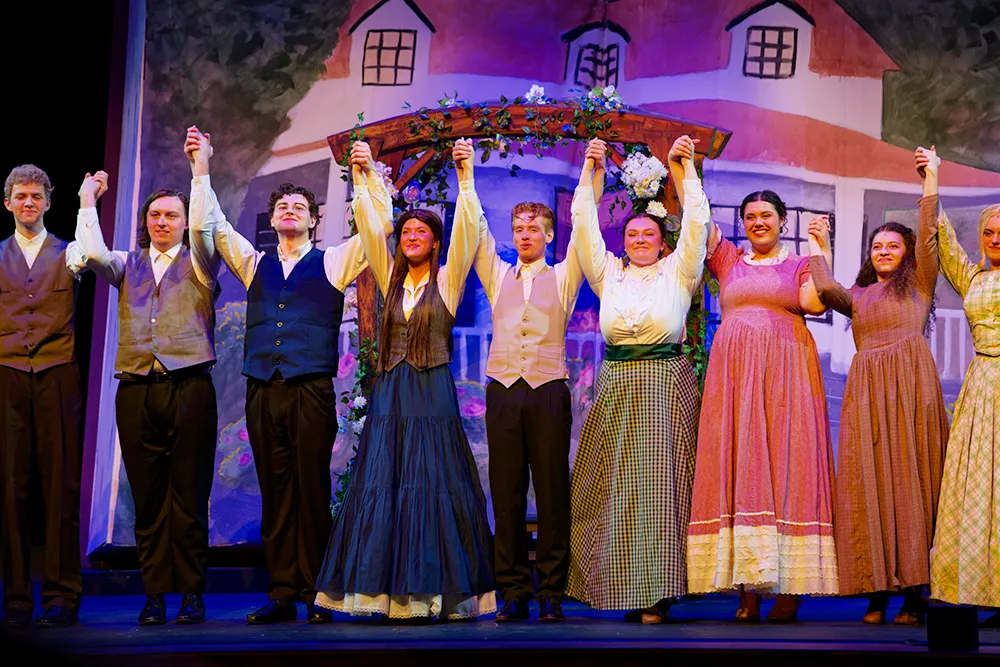
In spring 2026, the musical Little Women explored family and sacrifice, while the play Silent Sky followed pioneering astronomer Henrietta Leavitt. To direct Silent Sky, IWU alumna Chenoa Simmonds ’26 took an astronomy course, bringing scientific inquiry into the work of storytelling.
Beyond the Arts
Anne Snyder, editor-in-chief of Comment, a Christian magazine examining faith, culture, and public life, discussed how beauty, truth, and Christian tradition provide a foundation for creativity and meaningful engagement with the world during her February 2026 visit. She argued that received traditions and boundaries can nurture rather than restrict creativity, and that beauty and truth belong together in Christian engagement with institutions and public life.
The spring also included student art exhibitions and a visit by Yale historian Carlos Eire, author of They Flew: A History of the Impossible. His research into reported supernatural events asks how a culture decides what is possible and how those assumptions influence its understanding of reality.
Beauty and Justice
Fall 2026 continued the exploration through Sadao Watanabe: Witness to Faith at the 1920 Gallery. A Japanese Christian artist, Watanabe interprets biblical scenes using traditional Japanese stencil printing, demonstrating how the Gospel can be communicated through an artist’s own cultural language.
The fall calendar also included an October campus visit by attorney and justice advocate Haejin Shim Fujimura and artist Makoto Fujimura, coauthors of Beauty and Justice. Their work connects artistic beauty with the sustained effort to serve people amid suffering and injustice.
Whether in rehearsal, onstage, in galleries, or around a book, the invitation of these experiences is the same: to begin to see as God does. Participants leave looking differently at themselves, their neighbors, and the world, and that vision follows them long after.
