The Voice of a Movement
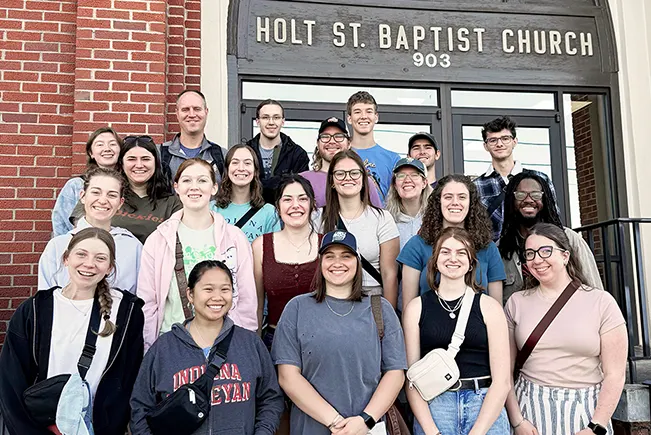
One of the trip's most powerful moments occurred at Holt Street Baptist Church in Montgomery, Alabama. This is where, on a December evening in 1955, thousands gathered to decide the fate of a bus boycott that had begun after Rosa Parks refused to give up her seat to a white passenger.
The Black pastors of Montgomery had hastily formed the Montgomery Improvement Association and elected a young newcomer to lead them: 26-year-old Martin Luther King Jr., who, as fate would have it, arrived late to the meeting.
“They were all kind of hesitant because they knew whoever was the head is going to be the target of any backlash from this boycott,” Hawkins explained. King, relatively new in town and having made few enemies, wasn't there to turn it down. When he arrived and learned of his election, he was told he had 20 minutes to write a speech for the mass meeting that night.
“You can read about what people did and what happened to them, but there’s something about being in the space where it happened that makes it come to life much more than just learning about it in the classroom.”
MADDIE SEITZ, ’27
Thousands showed up at Holt Street Baptist Church. It took King 15 minutes just to reach the pulpit from the back of the packed sanctuary. Unfortunately, he forgot his notes in the pew and had to deliver the speech from memory.
“He just knocks it out of the park,” Hawkins said. “It's such a powerful speech, if you know the context, know what's at stake. Basically, King's saying 'Let's keep this movement going. Let's keep the boycott going. We're Americans, we're Christians. This is the right thing to do, and we're going to be nonviolent.' This sets the scene for the movement for the next ten years.”
At the prompting of his wife Coretta, who couldn't attend, the speech was recorded; a remarkable feat of foresight that allowed Hawkins's students to hear King's words in the very sanctuary where he delivered them.
For years, the church building had fallen into disrepair, and students could only sit on the curb outside, listening to the speech on a Bluetooth speaker. But recently, the congregation that had relocated to a new building began restoring the historic sanctuary, converting it into a museum. This year, students sat in the same pews where Rosa Parks sat, absorbing King's words in the space that helped launch a movement.
Unabridged
“‘Education is the key to equality.’ It’s our responsibility to understand and educate ourselves on the history of our nation to reach the point of equality, and we still have more to do before we reach full equality.”
MK KING, ’27
Hawkins wants students to grasp the true scope of the struggle, not an abbreviated version that permeates the collective conscience.
“We have a tendency to think that the Civil Rights Movement is fairly easy, perhaps a three-day affair,” he said. “Rosa Parks sits on a bus, then Martin Luther King goes to D.C. and gives a speech, and then Denzel Washington coaches the Titans and, you know, racism is solved. That it was inevitable and, of course, going to happen the way it happened. We want the students to appreciate the amount of sacrifice, violence, and struggle over those ten years.”
Throughout the journey, students discussed what motivated people to keep sacrificing in the face of such hatred. “We talked a lot about the fact that this was a movement that grew out of the Black church, and that it was faith that sustained them,” Hawkins said.
Looking at the rhetoric of the speeches, this Christ-centered motivation becomes clear. “We're doing this because Jesus is behind this,” Hawkins paraphrased, “and we're doing this because we're followers of Jesus.”
Reckoning and Reconciliation
For Hawkins, the trip addresses a critical moment in how Americans understand their own story.
“We're living through a moment where the history of America and the story we tell about ourselves is very much up for grabs,” he said. “Trips like this, I think, are crucial for students to understand what's happened and what needs to happen moving forward.”
He pushes back against the notion that acknowledging past failures is hypercritical. “There's this tendency to think that if you're saying something bad happened in the past, then you're not being patriotic,” Hawkins said. “I think it's the opposite. If we're able to talk about bad things that have happened in the past, and how we have learned from that as a nation, then that's super patriotic. Maybe we do ourselves a disservice to act as if everything has always been great.”
He finds a spiritual dimension in this honest reckoning. “One of the things I always emphasize to my students in my history classes,” Hawkins said, “is when you read the Psalms, these songs that are offered up to God as acts of worship, so many of them are simply remembrances of times that Israel did something wrong. There's something that's profoundly Christian about remembering the ways that we have not been right in the past, so we can celebrate the way God forgives us anyway and can help us move forward into something new.”
As the bus pulled back into Indiana late that Sunday evening, the students carried more than memories. They carried the weight of witness, and the responsibility to tell these stories truthfully, so history's hard-won lessons aren't forgotten.