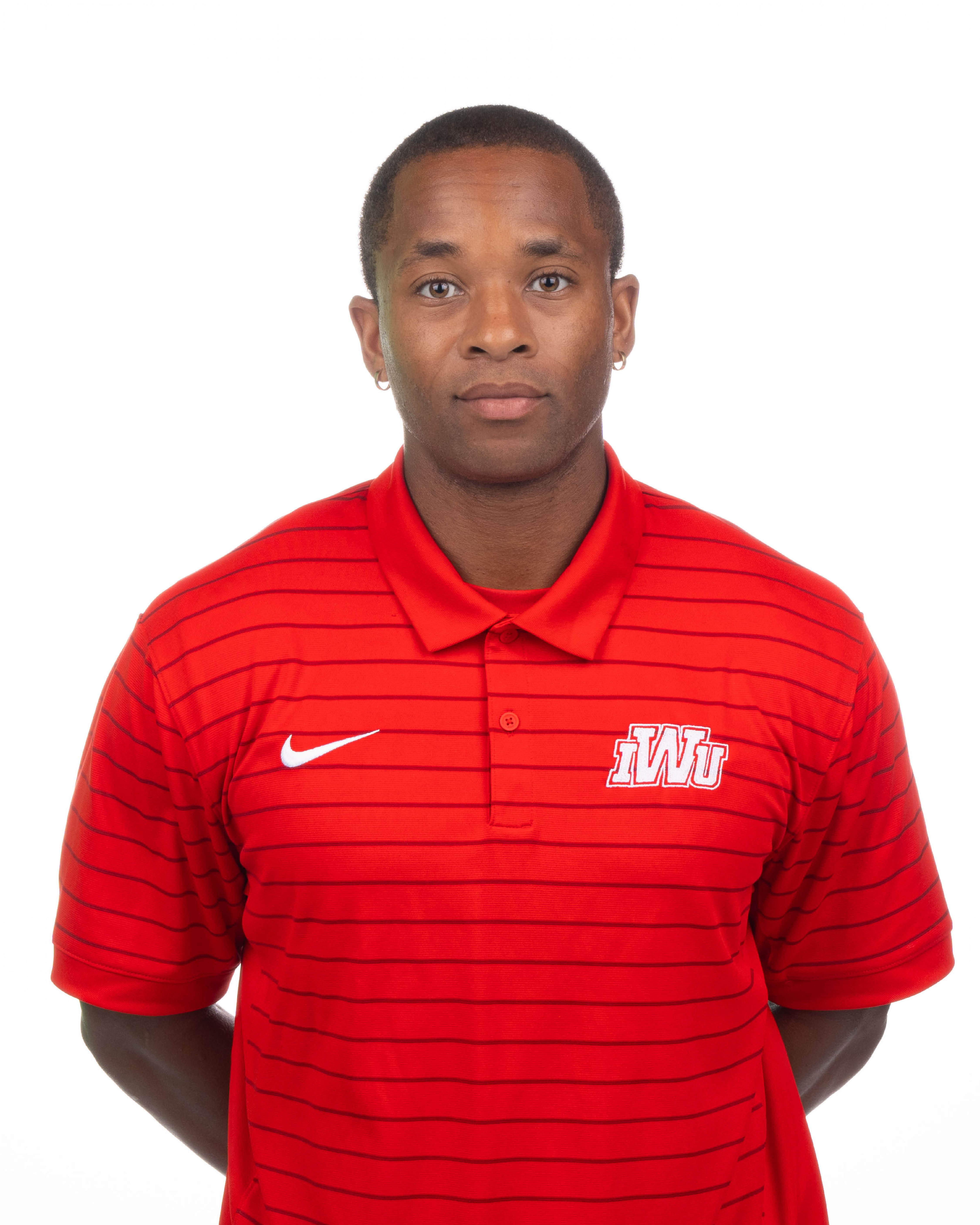
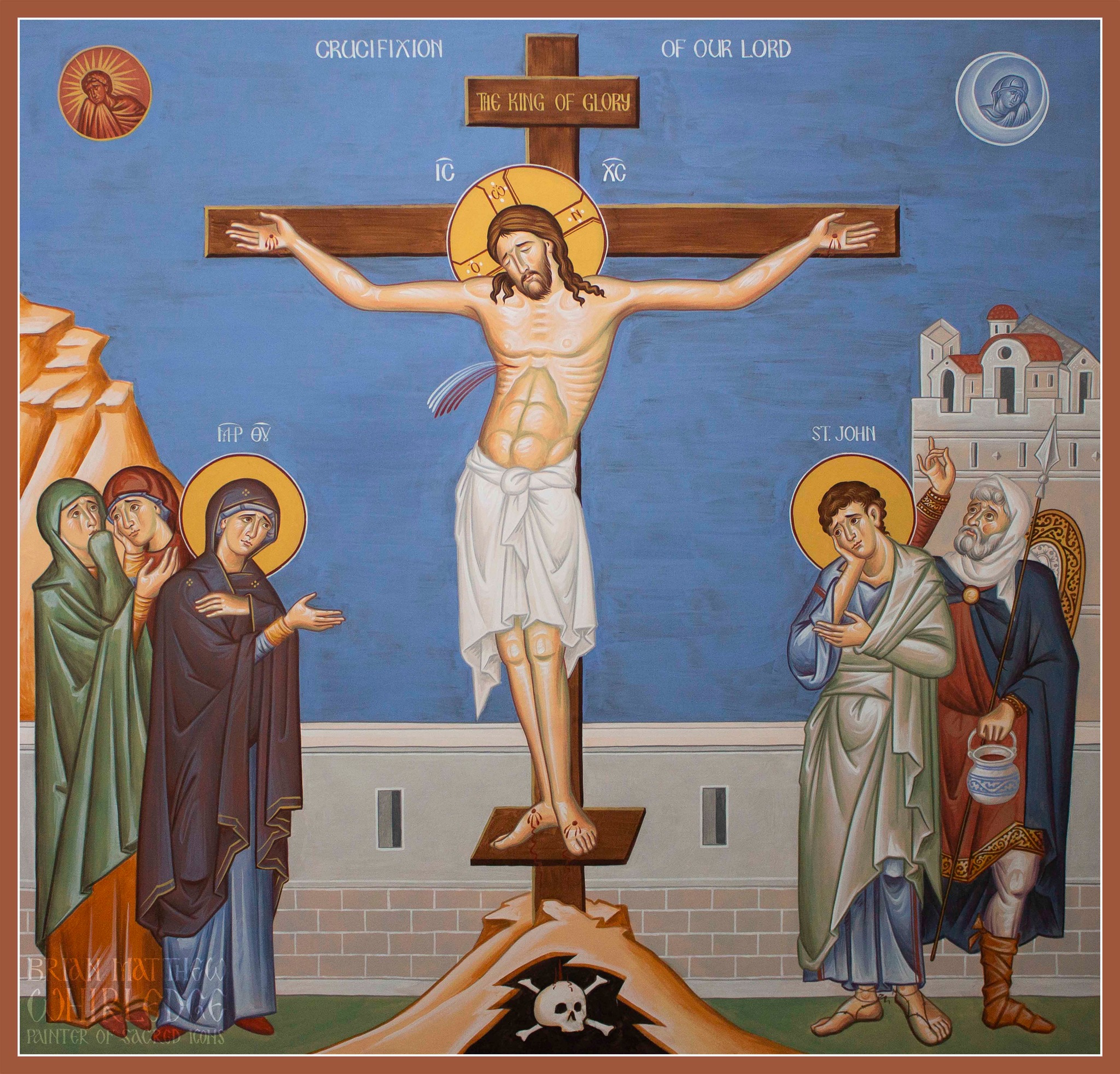
He mixes the pigment of finely crushed minerals into an egg yolk medium. On a wooden panel sealed with rabbit skin glue and chalk, he paints an image of Christ hanging from a cross, divine suffering writ upon His face. He applies a final varnish and steps back. What painter Brian Whirledge sees in the finished product is matter transfigured into the image of God.
The 2007 Indiana Wesleyan University (IWU) graduate has built a thriving career as an iconographer, creating sacred images that serve as visual prayers for churches and homes across the country. Working in the medieval Byzantine tradition, Brian merges technical skill with theological depth, producing art that helps Christians engage their senses in worship.
"Icons are the gospel in color," Brian said. "The painting itself is a visual prayer, yes, but also simply having the icons present in your church or home reveals God's presence."
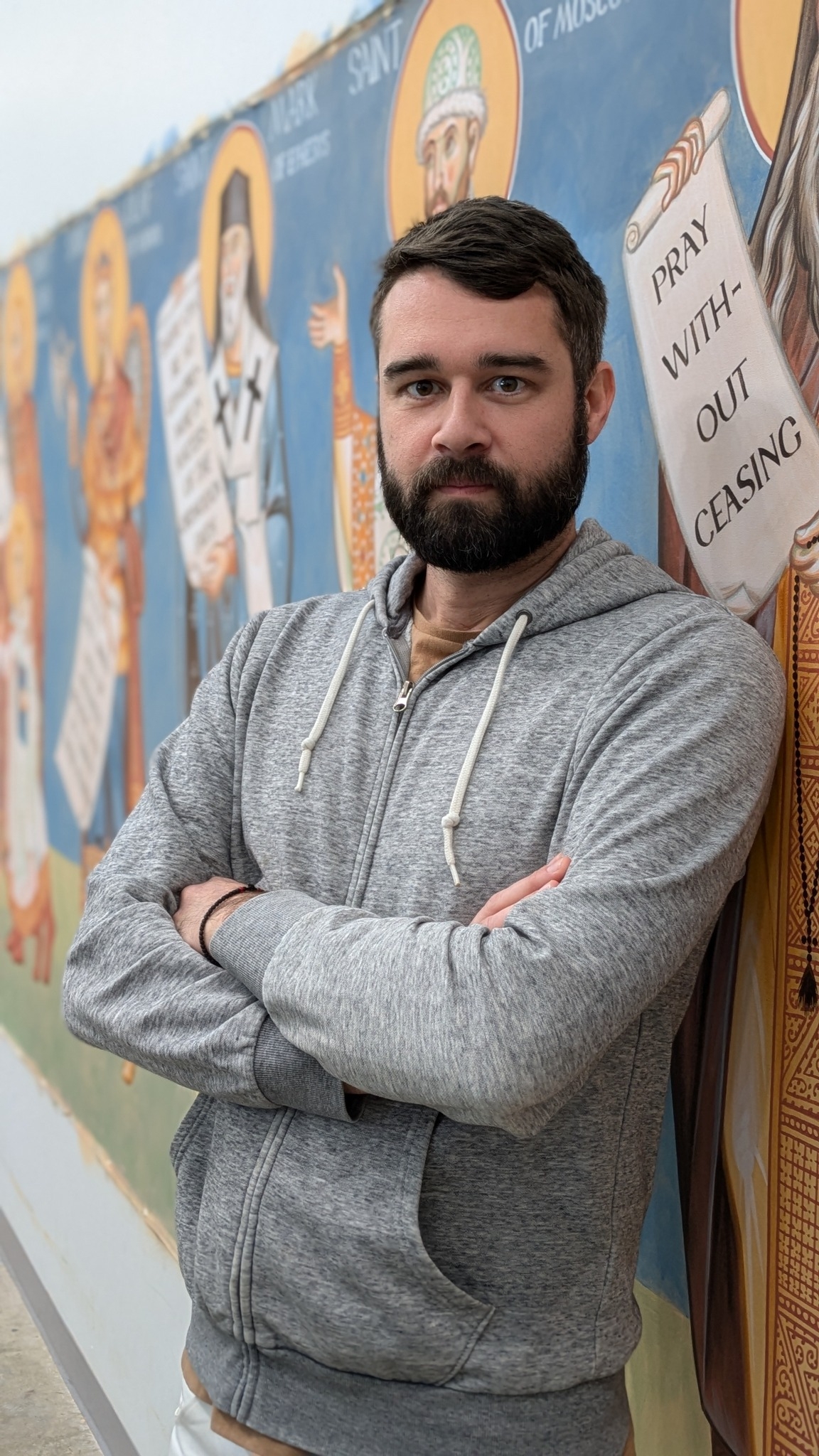
Painter of Sacred Icons
Growing up a pastor’s kid in northern Indiana, faith and art were always important to Brian, but finding a home for those two passions to live in harmony proved challenging.
He came to IWU to study art education, drawn by the Christ-centered culture and the art faculty. "I love the spiritual life of the campus," he said. "I was really impressed with my campus visits, and with the professors especially." Those professors, including Rod Crossman and Daniel Hall, helped him build a foundation in technical drawing, painting, color theory, and design. But still he wrestled with a deeper question: how does an artist make work that truly serves the Christian faith?
"My faith has always been important to me. I feel like God's given me this talent. So, how do I combine these two things?" he said, struggling to see a clear space for sacred visual art within the Evangelical tradition he knew best. During his time at IWU, Brian explored various Christian traditions and discovered the rich visual heritage of ancient Christianity. He was particularly struck by sacred art's role in worship and prayer.
By his junior year, he began attending an Orthodox church in Kokomo, and shortly before graduation in April 2007, he formally joined the Orthodox Church. That summer, he traveled to a Romanian Orthodox monastery in Michigan to learn the specific techniques of Byzantine iconography. "I took what I learned from all the technical drawing and painting and color theory and design that I learned at IWU, which is essential," Brian said, "and applied it to the painting of sacred icons, to support Christian worship.”
After graduating, Brian taught public school art for 15 years while painting icons on the side. He taught icon classes, took small commissions, then larger mural projects, and the work steadily grew. Around 2020, his commissions skyrocketed. He found himself booked out a year in advance, essentially working two full-time jobs. In a calculated leap of faith, Brian left teaching in 2022 to paint icons full time. Today, he's booked out approximately two years.
An apprentice helps him in the studio, particularly on murals, and creates the wooden boards Brian paints on. The process itself connects to ancient traditions. He uses chalk and rabbit skin glue as primer, then paints with egg tempera, mixing egg yolk with ground pigments from colorful minerals. "We're taking creation—elements from the mineral kingdom, the animal kingdom, and the vegetable kingdom—and we're combining them together to create the image of Christ and his saints," Brian said. "We're taking matter and transfiguring it, transfiguring creation."
A Visual Orthodoxy
For Brian, icons serve a profound purpose beyond decoration. They help believers focus their minds and hearts during prayer and worship. "Praying with icons is really a powerful experience, because you're looking Christ in the face, eye to eye, and it gives you something to turn your attention to as you're praying," he said.
This visual focus addresses a universal challenge in worship: wandering minds. Brian noted that it's inevitable for attention to drift during services or personal prayer. Icons provide something meaningful to meditate on. "With all these icons around, it's kind of okay to be distracted, because you're not really distracted by worldly things," he said. "If your mind wanders away from the hymn or the sermon and you find yourself looking at an icon of Christ's transfiguration or Palm Sunday, that’s something sacred to meditate on."
The theological foundation for religious art, Brian explained, is rooted in Scripture. "It really began in Genesis 1, the very beginning of creation. The word ‘icon’ is Greek for ‘image,’" he said. "God says, 'Let us make man in our image.' And so, man images God, including in the creative work." He also points to Exodus, where God commands Moses to create visual art for the tabernacle, including embroidered curtains with images of angels and statues of cherubim for the Ark of the Covenant.
The incarnation of Christ, Brian said, makes religious imagery not only permissible but necessary. "Icons are not only okay, but they're also necessary because of the incarnation," he said. "God became man in the person of Jesus Christ. When he was here on Earth, and people saw his face, they were seeing the face of God."
Quoting the theologian St. John of Damascus, Brian added, "I will venerate matter because God used matter to save me. God took on matter. He took on a body. He worked our salvation through matter. And therefore, it's appropriate to use matter to depict him."
This transformation of matter serves worship by revealing theology visually. "In Orthodox worship, the liturgy, is eschatological," Brian explained. "When we're in church during the Divine Liturgy, we're stepping outside of space and time. We're at the wedding banquet of the Lamb; we're in Heaven." He went on to cite Hebrews 11, which describes believers as "surrounded by this great cloud of witnesses." Icons, he said, reveal that reality during worship.
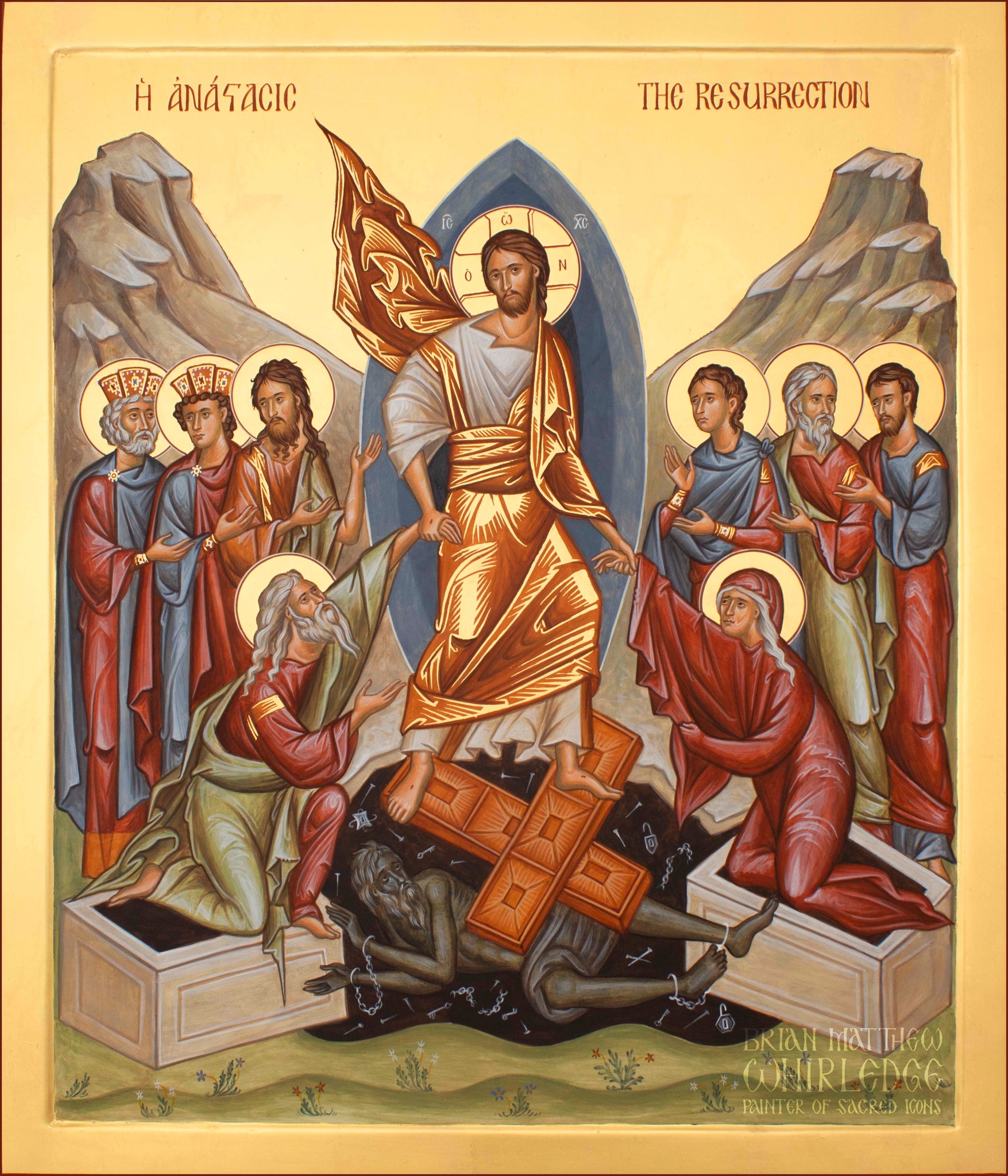
The images also invite participation in the eternal aspects of Christ's life. "We're not just remembering things that happened in the past. We're participating in them. Because there's an eternal component to Christ's Nativity, His Baptism, His Transfiguration, and His Crucifixion and Resurrection," Brian said. "Yes, they happened historically in space and time, but there's also an eternal element that we participate in."
Creating Holy Ground
For Brian, the work carries deep personal meaning. Each day brings him face to face with the subjects of his art. "It's very rewarding. I get to spend every day face-to-face with Christ and the saints," he said. "It's a beautiful life. I'm very thankful."
The icons serve churches and homes, giving people a visual focus for their worship and preaching the gospel through color and line. They make sacred spaces, holy ground, out of ordinary rooms and reveal God's presence in tangible ways. "To make these churches beautiful, to give people a tangible focus for their worship," Brian said. "It preaches the Christian faith, the Gospel, by visual means."
Nearly two decades after graduating from IWU, Brian has found the answer to the question he wrestled with as a student: how to combine his God-given artistic talent with his Christian faith. The answer, painted in egg tempera on wooden panels, proclaims the Gospel in color to all who have eyes to see.
See more of Brian Whirledge's iconography on Facebook, Instagram, and his website, www.brianwhirledge.com. Prints can be ordered at Legacy Icons.