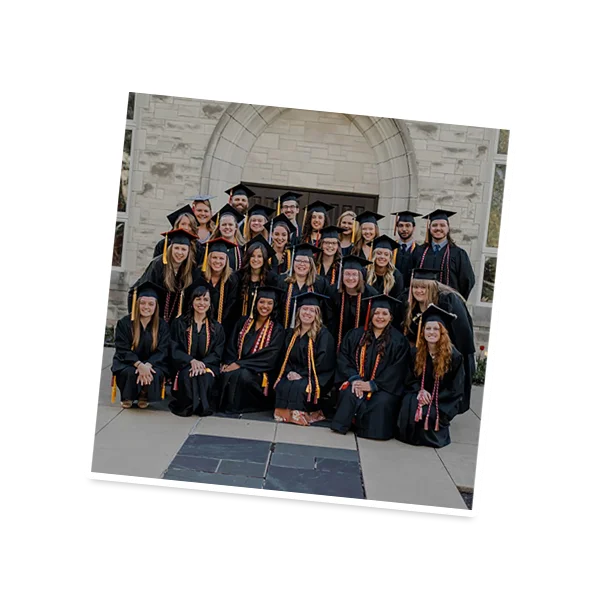
What does it mean to be wise? How do I learn to recognize what is true from what is false? How can what I learn in the classroom help me become not only smarter, but more compassionate, loving, and just? In the John Wesley Honors College, we ask a lot of questions. Our classes explore big questions: What Is Truth? What is the Good Life? What is Beauty? These questions are “big” because how we think about truth, goodness, and beauty affects how we understand the world and our role within it. They are the kinds of questions which take a lifetime to answer.
In the John Wesley Honors College, we want our students to succeed in their chosen careers, but more importantly, we want to see them live meaningful lives as followers of Christ. By drawing deeply from the wisdom passed down to us from our Christian brothers and sisters, we not only study virtues like justice, wisdom, and courage, we help you live them out.
To qualify for the JWHC, students must meet at least one of the following:
Prospective students who do not meet the admission criteria may petition to apply to the John Wesley Scholars, Luther Lee Scholars, or Mary C. Dodd Honors Programs.
Such students should submit an e-mail to jwhc.admissions@indwes.edu communicating why their academic preparation, intellectual character, and vocational objectives make them strong candidates for admission into an honors learning community.
If a student's petition is approved by the Honors College Admissions Committee, then he or she will be invited to apply to the John Wesley Honors College.


Having an honors degree on your transcript certainly looks good when you interview for that first job out of college or start applying for graduate programs in your field. Employers are also increasingly looking for graduates with humanities degrees that train you with skills like communication, empathy, and working across difference in a globalizing world.
But the real world does not wait until graduate: you are living it now. We believe the type of education you choose matters for how you are formed—not only as a future professional but also as a person today. A JWHC education is focused on both. Be part of a learning community that will have smaller average class sizes, more opportunity for discussion and deeper exploration, and integration with your other classes across the curriculum with peers who desire to learn like you do to become more Christ-like and more fully human.
Experience the John Wesley Honors College firsthand. Meet faculty and current students, explore the Honors College community, and discover what makes the JWHC experience unique.
Spend the day experiencing the John Wesley Honors College community, meeting faculty and students, and discovering how JWHC combines academic excellence, Christian formation, and meaningful relationships.
Loading upcoming dates...
The JWHC curriculum is rooted in the “Big Questions” of human existence. These questions beg answers from the historic Christian tradition and all different academic disciplines, and our interdisciplinary humanities courses build on each other to equip you with the skills and knowledge to tackle them. JWHC students learn more than subjects; you will learn to live holistically as you are formed to be more Christ-like.
By completing the Honors College curriculum, you will graduate with a double major in Honors Humanities alongside your major in your chosen discipline*. The Honors College coursework will also fulfill any core requirements you have not already fulfilled with pre-college coursework.
Download Honors Humanities Major course sheet
*An abbreviated honors minor (the Mary C. Dodd Scholars program) is available for current college students who transfer to IWU.

We recommend applying to the JWHC even if you aren’t yet committed to IWU. The application and interview process will help you get to know the JWHC community and discern whether it will be a good fit for your college experience.
Questions about the application or interview process? Email Julia VanderMolen
Take the first step toward joining the JWHC community by submitting your application online.
Two recommendations from non-family members are required; at least one of these should come from someone who knows your academic abilities well, such as a high school teacher.
Watch for an email to schedule your JWHC interview. We encourage in-person interviews at one of our two JWHC Spotlight Days, but virtual interviews can be scheduled if needed.
Every JWHC student receives a minimum $2,000/year tuition scholarship.
Four John Wesley Scholars receive $3,500/year scholarships.
One John Wesley Scholar receives a $6,000/year scholarship.







Students completing the Honors Humanities major are known as John Wesley Scholars.
Luther Lee Scholars is a selective cohort within the JWHC that partners the Honors Humanities major with co-curricular programming through the Intercultural & Global Office.
The John Wesley Honors College is an intentional learning community established to model and enrich IWU’s commitment to a Christian liberal arts education that nurtures lived wisdom. We thus strive for redemptive excellence by preparing our graduates to discern and inhabit God’s truth, to grow into the liberating virtues of Christ’s goodness, and to embody the sanctifying beauty of God’s reconciling love in a hurting world.
From founding Dean, Dr. David Riggs:
The most basic aspiration of the JWHC mission is for our community to exist as fertile ground for cultivating liberal arts learning. But what is liberal arts learning? We live in an era in which “liberal” is most familiar to Americans as a political adjective—cast as an aspersion by some and embraced with pride by others. The term however has a much longer history among the western traditions of education. Since at least the time of Plato, a “liberal” education has been a course of learning that liberates students from ignorance, delusion, and vice so that they can inhabit truth, goodness, and beauty as the essence of their lives.
This educational notion of “liberal” operates out of the following convictions:
While all liberal arts learning aims for this kind of liberating education, the precise character of this endeavor is ultimately determined by a community’s shared assumptions about what reality is and how human beings flourish within it. In other words, a liberal arts education is never neutral about what “truth” is, what pursuits may be described as “good,” and what phenomena are deemed “beautiful.” Every liberal arts learning community develops its curriculum and educational outcomes based on the plot and logic of the particular narration of reality its members—whether consciously or not—trust as the most reliable way to make sense of the world.
The shared vision of reality that animates our liberal arts learning community is the tradition of lived wisdom handed down within the historic Body of Christ. And so, we grapple with complex questions of truth according to a narration of reality that begins and ends with a Triune God who created this world for human beings to share in His transcendent life and love. We cultivate lives of goodness that embody the virtues of Christ’s new humanity. And we contemplate the mystery and allure of beauty attentive to how God’s life-giving presence in creation inspires, nurtures, and completes our flourishing as relational creatures.
In an age in which higher education values occupational training more highly than the formation of meaningful lives, we stand in awe of how the Lord has directed and prospered the JWHC’s commitment to Christian liberal arts learning. And we relish in the opportunity to welcome students into an educational journey that can transform how they see and live into the realities of God’s world. JWHC students major in a broad variety of disciplines and they graduate into successes in every possible profession; but they do so equipped by their Christian liberal arts education to steward their everyday lives according to the redemptive power of God’s truth, goodness, and beauty.

The Honors College is developing creative, critical-thinking servant leaders to help shape tomorrow's world. Thanks to their honors learning experiences and mentoring relationships with first-rate faculty members, JWHC graduates have consistently distinguished themselves in their post-IWU careers. They have entered graduate programs at schools such as Oxford, Princeton, Duke, Michigan, University of Chicago, and Eastman School of Music. They have become authors, poets, artists, and journalists. They have embarked on leadership tracks in corporations, schools, churches, hospitals, charities, and government. But most importantly, they have become well-informed, reflective, and compassionate agents of Christ in a desperately hurting world.
We love to hear from our alumni! Email honors.office@indwes.edu with life updates.