 B.S. Nursing Degree
Next Start |
B.S. Nursing Degree
Next Start |
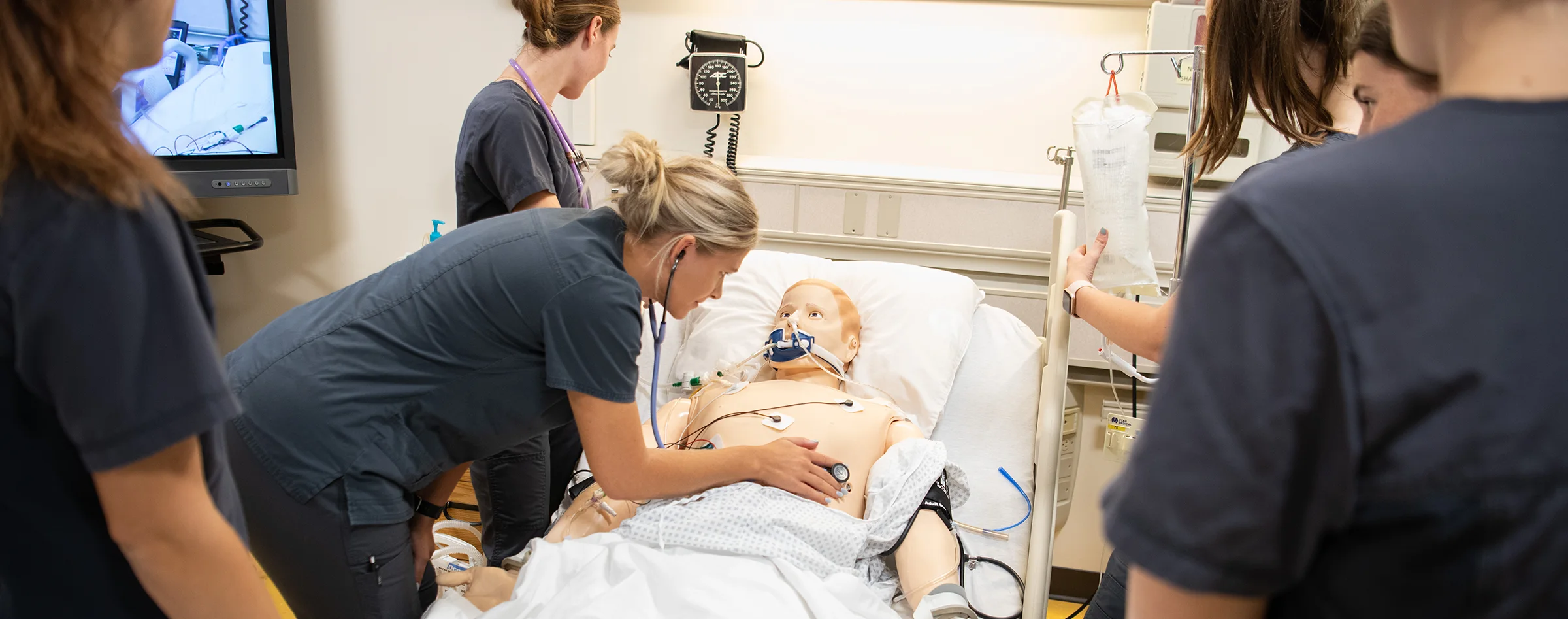
Do you want to pursue a career in the rapidly growing field of healthcare as a nurse? Start with an accredited nursing program from Indiana Wesleyan University. Our Bachelor of Science in Nursing covers the instruction in evidence-based nursing practices needed to start your career in nursing or pursue graduate-level studies.
If you have a passion for helping others heal and want to learn at a Christian university, this pre-licensure nursing program was designed for you. Nursing careers are expected to grow 6% between 2023–2033, according to the Bureau of Labor Statistics (BLS). This is double the national average of 3% for all other occupations. Plus, we lock in your tuition rate from the moment you begin—so your nursing program cost stays consistent, giving you peace of mind and protecting you from future increases.
At IWU, your nursing education is more than a degree. It’s preparation for a life of service. There are several benefits to pursuing your pre-licensure nursing education here. From tech support to tutoring, our comprehensive student services are designed to help you succeed in this Bachelor of Science in Nursing program. And our accredited degree programs are taught by experienced faculty who are experts in their fields. From clinicals to NCLEX preparation courses, they will become your mentors in the faith, integrating classroom learning with biblical truths for a Christ-centered environment that encourages spiritual growth.
We also offer support navigating nursing school scholarship opportunities and understanding nursing degree requirements so you can focus on what matters most: becoming the best version of yourself—for others.
You will learn how to become an RN. The Bachelor of Science in Nursing program at IWU is designed to give you a strong foundation in the knowledge and delivery of care skills you can build on as you pursue licensure. Throughout the program, you will engage in a curriculum that combines coursework and clinical practice. This experiential approach will help you develop the confidence and patient communication skills to deliver effective, empathetic care. Course topics cover anatomy, physiology, pharmacology and more.
IWU has provided education for more than 100 years.
Faith-integrated curriculum and a commitment to changing the world.
Center for Student Success for counseling, tutoring, and more!
IWU surpasses the national averages in a number of important educational benchmarks, including, but not limited to: higher than average graduation and career outcome rates. Plus, compared to the national average, IWU students receive their education with lower than average student debt!
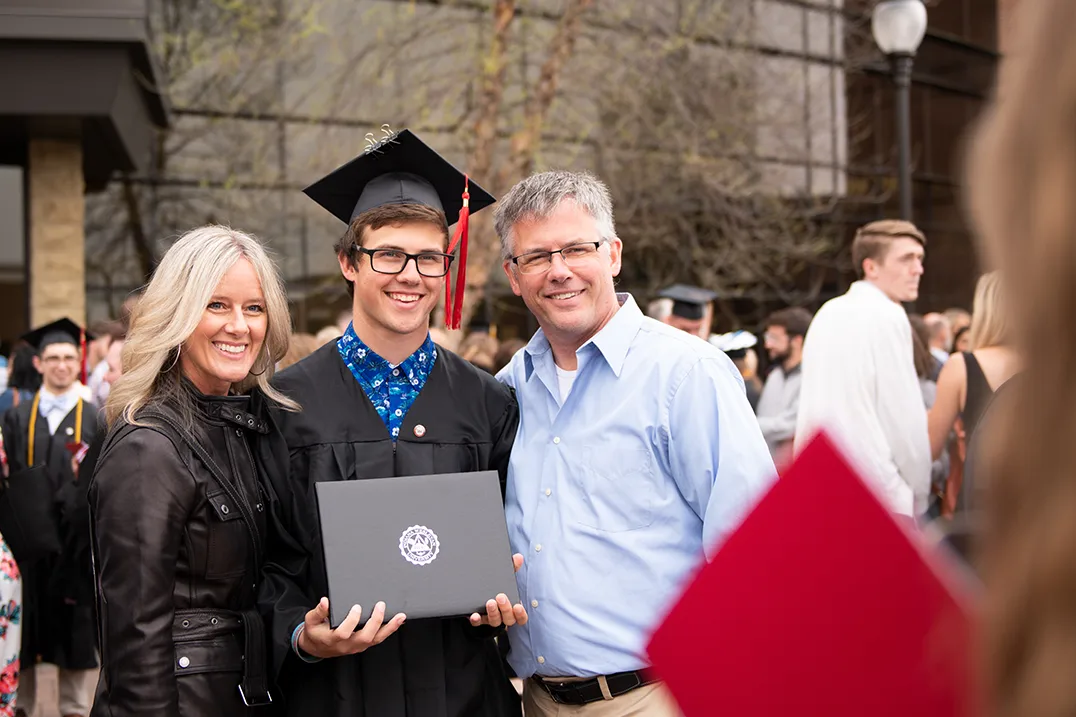
Coursework for your Bachelor of Science in Nursing covers everything you need to pursue licensure and fulfill registered nurse responsibilities in multiple healthcare settings. Your program includes:
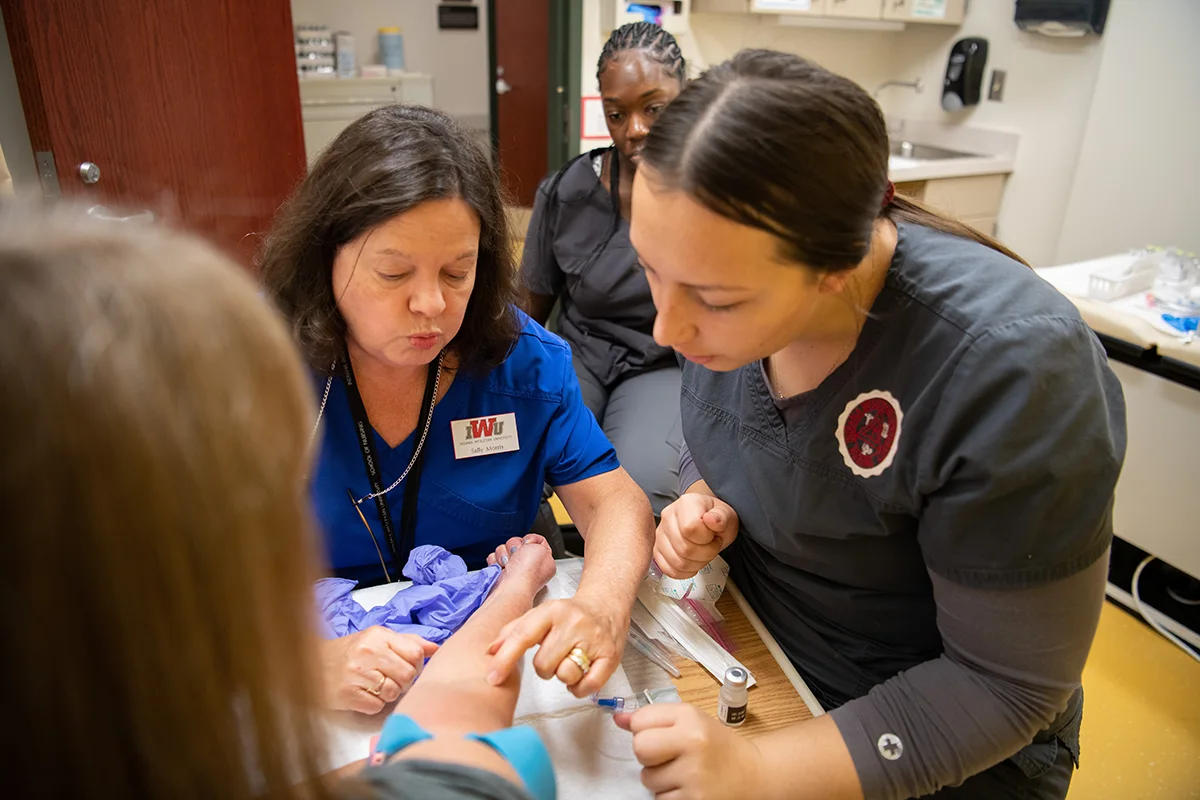
These courses contain the program-specific knowledge. Upon completion, you should have the tools to conquer your new career with confidence. For a full list of courses and prerequisites required to complete your degree, please visit the course catalog. Click on a course below to view the description.
NUR-145,NUR-213,NUR-221,NUR-232,NUR-242,NUR-246,NUR-249,NUR-250,NUR-260,NUR-260L,NUR-300,NUR-313,NUR-336,NUR-349,NUR-353,NUR-355,NUR-357,NUR-400L,NUR-449,NUR-470,NUR-471,NUR-473,NUR-485,BIO-111,BIO-112,BIO-113,CHE-120,PSY-150,PSY-250,ENG-120,COM-100,THE-101,BIL-101,BIL-102,ENG-180,HST-180

1.Achieving a C or higher in all NUR courses.A student who does not meet one or more of these minimum requirements will be placed on nursing academic probation.
2.Maintaining a nursing GPA of 2.75 or higher (NUR courses only).
3.Maintaining a cumulative GPA of 2.75 or higher (all IWU courses).
Criteria 1: C- or lower in one or two NUR course/s (considered course failure).Two probationary periods are permitted during entire enrollment in Pre-Licensure nursing.
Criteria 2: NUR GPA of less than 2.75.
Criteria 3: CUM GPA of less than 2.75.
Criteria 1: Failure (C- or lower) of three NUR courses (in one or more semesters/terms).READMISSION
Criteria 2: Failure (C- or lower) of the same NUR course twice.
Criteria 3: Failure to meet the requirements to be removed from probation by the end of the
second probationary period.
Criteria 1: Three years have passed since dismissal
Criteria 2: All sciences completed within 5 years of readmission or work in a field utilizing the sciences
Criteria 3: Completion of twelve credit hours from an accredited college/university with a GPA of 2.75 prior to readmission
Criteria 4: Interview with the SON Dean of the Pre-licensure Division of Nursing or a designee
Criteria 5: May be required to audit or repeat courses according to IWU’s Repeating Course Policy
Criteria 6: All other Pre-licensure admission requirements
REQUIREMENTS DURING PROBATION
A student on probationary status due to Probation Criteria 1 (C- or lower in one or two NUR course/s) must do the following:
FIRST PROBATION
SECOND PROBATION
A student on probationary status due to Probation Criteria 2 (NUR GPA of less than 2.75) must do the following:
FIRST PROBATION
SECOND PROBATION
A student on probationary status due to Probation Criteria 3 (CUM GPA of less than 2.75) must do the following:
FIRST PROBATION
SECOND PROBATION
REMOVAL OF PROBATIONARY STATUS
A student will be removed from probationary status for the next semester/term after all requirements are met as stated above and all other minimum academic requirements are maintained.
1.Achieving a C or higher in all NUR courses.A student who does not meet one or more of these minimum requirements will be placed on nursing academic probation.
2.Maintaining a nursing GPA of 2.75 or higher (NUR courses only).
3.Maintaining a cumulative GPA of 2.75 or higher (all IWU courses).
Criteria 1: C- or lower in one or two NUR course/s (considered course failure).Two probationary periods are permitted during entire enrollment in Pre-Licensure nursing.
Criteria 2: NUR GPA of less than 2.75.
Criteria 3: CUM GPA of less than 2.75.
Criteria 1: Failure (C- or lower) of three NUR courses (in one or more semesters/terms).READMISSION
Criteria 2: Failure (C- or lower) of the same NUR course twice.
Criteria 3: Failure to meet the requirements to be removed from probation by the end of the
second probationary period.
Criteria 1: Three years have passed since dismissal
Criteria 2: All sciences completed within 5 years of readmission or work in a field utilizing the sciences
Criteria 3: Completion of twelve credit hours from an accredited college/university with a GPA of 2.75 prior to readmission
Criteria 4: Interview with the SON Dean of the Pre-licensure Division of Nursing or a designee
Criteria 5: May be required to audit or repeat courses according to IWU’s Repeating Course Policy
Criteria 6: All other Pre-licensure admission requirements
REQUIREMENTS DURING PROBATION
A student on probationary status due to Probation Criteria 1 (C- or lower in one or two NUR course/s) must do the following:
FIRST PROBATION
SECOND PROBATION
A student on probationary status due to Probation Criteria 2 (NUR GPA of less than 2.75) must do the following:
FIRST PROBATION
SECOND PROBATION
A student on probationary status due to Probation Criteria 3 (CUM GPA of less than 2.75) must do the following:
FIRST PROBATION
SECOND PROBATION
REMOVAL OF PROBATIONARY STATUS
A student will be removed from probationary status for the next semester/term after all requirements are met as stated above and all other minimum academic requirements are maintained.
IWU’s Pre-Licensure Nursing faculty bring extensive clinical and teaching experience to the classroom.
Dr. Abby Flenar is a neonatal intensive care specialist with 19 years of experience and a focus on maternal health and mortality prevention.
Dr. Megan Greentree brings experience in pediatric nursing and simulation, with a focus on nurse transition-to-practice and retention.
Dr. Corey Sizelove is a practicing emergency nurse practitioner who brings current clinical expertise in trauma and disaster care to the program.
You can contact IWU’s Financial Aid Office for assistance with financial aid questions. Typical response times are 24–48 hours.
Pre-Licensure Nursing also awards more than $1 million in nursing scholarships annually.
IWU’s BSN program combines clinical practice, simulation, global learning, and close faculty mentorship to prepare you for professional nursing practice.
You’ll participate in senior immersive clinical experiences, including one-on-one experiences with nurses and a capstone clinical. The program also offers global transcultural immersion opportunities and advanced simulation experiences using high-fidelity equipment and virtual reality.
Small class sizes of approximately 20–30 students and clinical groups of about 5–8 students provide additional opportunities for individualized learning and faculty mentorship.
IWU’s BSN program prepares graduates for nursing careers in hospitals, community healthcare, specialty practice, and other clinical settings. Graduates may also pursue advanced nursing education.
The program includes preparation for the National Council Licensure Examination for Registered Nurses (NCLEX-RN), and graduates are prepared to seek employment across a variety of healthcare settings.
Three courses provide focused preparation as students approach graduation:
Recent Pre-Licensure Nursing graduates are working in a variety of clinical specialties.
Paige Ruegssegger works as a Medical ICU nurse, Elisha Hoover works as a Labor and Delivery RN, and Izzy Reed works as a NICU nurse.
After completing the BSN, graduates typically take the NCLEX-RN within one to two months and then begin their nursing careers after meeting applicable licensure requirements.
The program prepares students for the transition from graduation to licensure and employment.
Clinical experiences begin during the sophomore year.
You’ll complete clinical placements in diverse healthcare systems, giving you opportunities to apply classroom knowledge in professional care settings as you progress through the nursing curriculum.
The BSN is an on-campus program that includes in-person clinical experiences, simulation laboratory experiences, and transcultural learning opportunities.
These experiences allow you to develop and apply nursing knowledge and clinical skills through hands-on learning in both simulated and professional healthcare environments.
You should expect to commit approximately 35–45 hours per week to your nursing education.
This time may include classes, clinical experiences, labs, studying, assignments, and other academic responsibilities.
The traditional BSN pathway is designed to be completed in approximately four years.
An accelerated track is also available, with the nursing-course portion designed to be completed in approximately 14 months for eligible students.
You’ll begin by completing prerequisite coursework and an entry-level nursing course. After your first year, you’ll apply to the nursing major.
Faculty provide guidance as you progress through the program, from your initial coursework through licensure preparation and the transition to your first nursing position.
You’ll have access to academic advising, tutoring, career services, and faculty mentorship throughout your nursing education.
Faculty relationships are an important part of the student experience, providing both academic guidance and individualized support as you progress through the program.
BSN students build close relationships with faculty who provide mentorship throughout the program.
These relationships support academic development, professional preparation, and personal growth as students prepare to transition into nursing practice.
The BSN program uses structured clinical experiences rather than traditional internships.
Clinical experiences provide hands-on opportunities to apply nursing knowledge and develop professional skills in healthcare settings under appropriate supervision.
Transfer credits are evaluated individually to determine how previous coursework may apply toward BSN degree requirements.
Yes. Experiential learning is incorporated throughout the nursing curriculum through immersive clinical experiences, a transcultural practicum, and a Nursing Leadership capstone.
These experiences give students opportunities to integrate knowledge and clinical skills as they prepare for professional nursing practice.
IWU’s BSN program combines rigorous nursing education with individualized support, clinical preparation, and a faith-based approach to holistic care.
Qualified students are guaranteed a seat without a nursing program waitlist. Pre-Licensure Nursing also awards more than $1 million in nursing scholarships annually.
Students benefit from strong student-faculty relationships and an approach to nursing that emphasizes caring for the whole person.
Students who value a supportive, relationship-centered learning environment are well suited for IWU’s BSN program.
The program combines academic rigor with faculty support, mentorship, and opportunities for personal and professional growth.
The BSN student experience emphasizes rigor, grace, and personal growth.
Students have opportunities to participate in travel, service, global engagement, clinical learning, and other experiences that extend their education beyond the classroom.
Christian faith is integrated throughout nursing coursework, clinical care, and service opportunities.
Students are encouraged to consider the needs of the whole person—body, mind, and spirit—and explore how their calling can shape compassionate care for patients and communities.
Discover the way ahead with an accredited nursing program at IWU. Pursue a career in the growing field of healthcare as a nurse with our comprehensive Bachelor of Science in Nursing!
Request Info Apply Now