 B.S. Medical Technology Degree
Next Start |
B.S. Medical Technology Degree
Next Start |
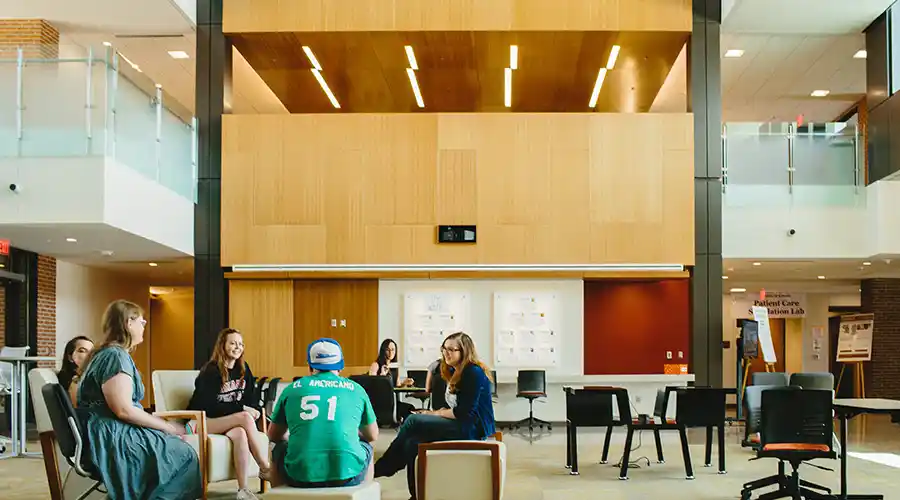
If you want a technology-based career in the rapidly growing field of healthcare, the BS in Medical Technology at Indiana Wesleyan University was designed for you. Medical technologists will play a crucial role in the detection, diagnosis, and treatment of disease. After completing this program, graduates are eligible to take the appropriate national registry examination. After passing their national qualifying exam, students can pursue employment in hospital laboratories, government medical laboratories, medical research laboratories, clinics, and health care centers. At our Christian university, you can learn how to combine biblical principles with this Bachelor of Science in Medical Technology program.
This program prepares students for real-world career opportunities in clinical laboratory science. Courses are taught by experienced faculty who have worked in healthcare and clinical pathology settings.
You will complete hands-on clinical training at an approved clinical site, gaining experience with advanced equipment and real patient testing. IWU also offers strong student support, including tutoring and tech help. Faculty serve as mentors, helping you grow in both your career and your faith.
This degree program combines classroom learning with hands-on clinical experience. During the first three years, you will complete prerequisite courses in biology, chemistry, and other sciences. In the fourth year, you will complete a full-time clinical training experience in a medical laboratory.
IWU has provided education for more than 100 years.
Faith-integrated curriculum and a commitment to changing the world.
Center for Student Success for counseling, tutoring, and more!
IWU surpasses the national averages in a number of important educational benchmarks, including, but not limited to: higher than average graduation and career outcome rates. Plus, compared to the national average, IWU students receive their education with lower than average student debt!
In this medical technology major, you will learn how to:

These courses contain the program-specific knowledge. Upon completion, you should have the tools to conquer your new career with confidence. For a full list of courses and prerequisites required to complete your degree, please visit the course catalog. Click on a course below to view the description.
BIO-125,BIO-213,BIO-311,BIO-312,BIO-440,CHE-125,CHE-126,CHE-235,CHE-236,BIO-351,BIO-412

Dr. Warren Rogers: Endowed Chair of Physics, conducts research in nuclear physics, investigating and detecting neutrons arising from the decay of exotic nuclei.
Dr. Dan Jones: Professor of Biology, conducts research on dental osteonecrosis treatments.
Dr. Stephen Leonard, Associate Professor of Chemistry, conducts research on selective and potent inhibitors of the oncogenic tyrosine phosphatase SHP-2.
We direct students to Student Financial Services.
SCI 110 and PMD 110 are both first-year seminar courses that introduce students to areas of medicine and fields in STEM and the different career opportunities that are available within these fields. They learn about medical, dental, physician assistant and graduate school opportunities in research and medicine. Later through PMD 310 and BIO 490/CHE 490 they continue to explore career paths, participate in professional development (resumes, cover letters, interviews and LinkedIN). IWU offers HRI research fellowship opportunities for students to gain hands on experience mentored by IWU STEM faculty, IWU Wildcat Farm offers horticulture internships and we promote many local and national research and internship opportunities to students throughout the year. Faculty also provide guidance and mentorship to help discern next steps through advising and 1-1 mentor relationships, providing advice, expertise and letters of recommendation.
Our program provides preparation for a range of career professional career paths from science education to medicine to research in all areas of STEM. Specifically in the following areas these are paths students pursue:
Biology & Biochemistry
Biotechnology & Pharmaceutical Research: Developing new drugs, gene therapies, and vaccines. Roles include process development scientists, pharmacologists, and clinical trial coordinators.
Genetics & Bioinformatics Data Analysis: Analyzing genomic data to understand diseases or evolutionary history.
Healthcare & Medicine: Beyond becoming a physician, these degrees are essential for roles in diagnostic medical imaging, clinical laboratory science, and public health administration.
Chemistry
Material Science: Developing new polymers, batteries, or semiconductors. This is a massive field for chemistry majors interested in hardware and manufacturing.
Analytical Chemistry: Ensuring quality and safety in industries ranging from food and beverage to cosmetics and government regulatory agencies (FDA, USDA or EPA).
Chemical Engineering: Moving beyond the lab to scale up chemical processes for industrial production.
Physics
Data Science & Quant Finance: The mathematical modeling skills physicists develop are highly sought after by banks for risk assessment and algorithm development.
Aerospace & Defense: Working on propulsion systems, guidance software, and complex satellite communications.
Medical Physics: Designing and maintaining high-tech medical equipment like MRI, CT, and radiotherapy machines.
Environmental Science
Field Research and Biology: Conducts research on plants, animals, microbes etc.
Sustainability Consulting: Helping corporations reduce their carbon footprint, manage waste, and comply with environmental regulations.
Environmental Engineering: Designing water treatment plants, air filtration systems, and sustainable infrastructure.
Conservation & Policy: Working with NGOs or government agencies to influence land-use policy, manage ecosystems, and mitigate the effects of climate change.
Foundational courses such as BIO 125, CHE 125 and PHY 111.
Lucas Thomas, Medical School
Alec Foster, Medical School
Olivia Lucas, Graduate School
Entering the field as a STEM major, graduates can pursue research labs, working for zoos, botanical gardens, the government. Or graduates can pursue advanced degrees in graduate or medicine to become doctors or research scientists.
We have a strong community of students, faculty, and staff with many opportunities to gain hands-on experience and develop mentor-mentee relationships. We offer opportunities in research, to serves as a teaching assistant, lab prep assistant and horticulture internships.
This varies widely but for students wanting to pursue healthcare and medicine 1-3000 hours of patient contact hours is often required for graduate/medical schools.
Student have access to Student Thriving, Life Calling, IT, career services and tutoring.
Students can apply to intern at Wildcat Farm through an application and selection process supervised by Dr. Jennifer Noseworthy and Professor Jacob Buck. Otherwise students pursue many internship opportunities off campus both locally and nationally.
If so, how many credits may transfer, and what does the transfer evaluation process involve?
Often they can depending on the program and there is course transfer evaluation form students can fill out and it will be reviewed by the division chair.
Not usually, however if a student participates in an internship they can research credit for their experience if they arrange it in advance of the internship experience.
None are required but many conduct research and participate in IWU HRI Colloquium and Celebration of Scholarship presenting oral and poster presentations.
We have state of the art facilities in STEM, a campus farm, robust research opportunities and students are exceptionally prepared for medical and graduate school
Discover the way ahead in the field of healthcare with this comprehensive BS in Medical Technology program at IWU!
Request Info Apply Now