College is one of the biggest investments you'll make, and its value reaches far beyond the price tag. National research shows that bachelor's degree holders earn more, face lower unemployment, and build stronger long-term financial stability than people whose highest credential is a high school diploma.
The best college for you isn't always the one with the lowest price. Fit matters, too. At Indiana Wesleyan University (IWU), our financial aid team works with you one-on-one to make a Christian education affordable, so you can choose based on fit, not cost alone.
Before you compare colleges, it helps to know what a bachelor's degree is worth. Its financial return lasts far longer than your first paycheck.
Every path is different. A degree doesn't guarantee a specific salary or career, and results vary by field, location, experience, and other factors. But across the U.S. workforce, the long-term financial advantages of a bachelor's degree are significant.
In 2024, full-time workers with a bachelor's degree earned a median of $81,800 a year, compared with $50,600 for high school graduates. That's $31,200 more each year, or 62% higher earnings.
Source: College Board, Education Pays 2026
Bachelor's degree holders earn about $2.8 million in median lifetime earnings, compared with about $1.6 million for high school graduates. That's a $1.2 million difference over a working life.
Source: Georgetown University Center on Education and the Workforce, The College Payoff
A typical four-year graduate earns back the full cost of college, including tuition and missed wages, by about age 34 without grant aid. With average grant aid, that drops to around age 30.
Source: College Board, Education Pays 2026
In 2025, the unemployment rate for adults ages 25 to 34 with a bachelor's degree or higher was 3.1%, compared with 5.8% for high school graduates the same age. That's nearly half the rate.
Source: College Board, Education Pays 2026
97%
91% National Average for Private Schools
67%
63.25% Indiana Average
24.9k
$29.2K National Average
Where you go matters too. The value of your degree depends on what you pay, whether you finish, and where you land after graduation. Here's how IWU measures up.
In 2023–24, first-year IWU students receiving federal aid from families earning $75,000 or less paid an average net price under $20,000 after grants and scholarships.
Source: National Center for Education Statistics, College Navigator
IWU graduates who borrow leave with an average of $26,718 in federal student debt. Nationally, public university students borrow an average of $31,960 to earn a bachelor's degree.
Source: IWU Office of Institutional Research; Education Data Initiative
At IWU, 61.1% of students graduate within four years and 71.4% within six. Both rates top the national averages for private colleges: 56.8% and 68.0%.
Source: National Center for Education Statistics, College Navigator
Among IWU's Class of 2025 graduates with known outcomes, 97% were employed, continuing their education, serving in the military, or participating in volunteer service within six months of graduation.
Georgetown University estimates a 40-year return on investment of about $1.97 million in 2023 dollars for students at IWU's Marion campus, the highest among Indiana's CCCU member colleges.
Source: Georgetown University Center on Education and the Workforce, 2025 college ROI rankings
College is a significant investment. We want you to see both sides of it: what your education costs today, and what it can make possible for your career and calling in the years ahead.
The published price isn't the whole story. Scholarships, grants, and other financial aid can lower what you pay for an IWU education, so your actual cost may be very different. Explore tuition, then use the Net Price Calculator for a personalized estimate.

Indiana Wesleyan University listens to students and potential students on their financial aid needs! IWU invests over $25,000,000 in institutional aid based upon merit, need, and other factors, with many students receiving multiple awards, to make education as affordable as possible. Students can also use federal and state aid from Indiana.
Updated academic scholarships will be arriving fall 2026, so make sure to stay up to date on what financial aid is available by visiting our website often!
Indiana Wesleyan's average financial aid package to campus students is $21,249
To get started, complete the steps below to be considered for federal grant and student loan eligibility. You may then explore additional types of aid if supplementary funds are needed.
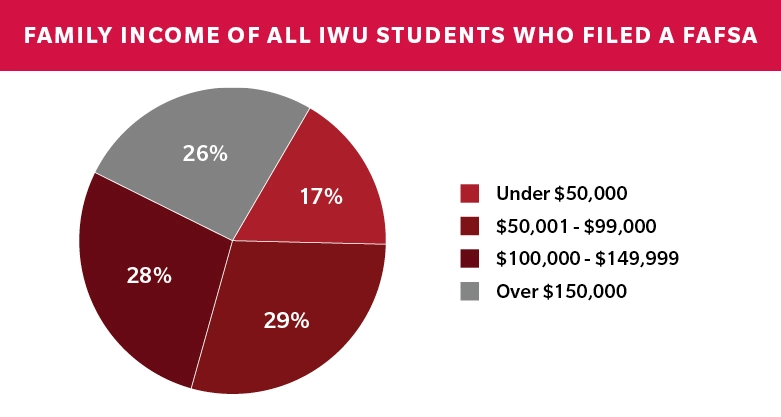
Any student, regardless of income, who wants to be considered for federal, state, and school financial aid programs should file the FAFSA. This includes grants, scholarships, and loans.
If you have not already done so, you must create a Federal Student Aid (FSA) username and password to log in.
Take some time to browse the various scholarships, grants, and other sources of aid that you may qualify for as an Indiana Wesleyan student.

Completing the Free Application for Federal Student Aid (FAFSA) is one of the first steps to discovering the best aid options available to making a Christian Education at IWU affordable.
The FAFSA helps determine what scholarships and grants a student may qualify for to help fund their education.
The FAFSA is an online form used by colleges to determine how much financial aid you're eligible to receive, which could include grants, scholarships, work-study funds, and loans.
Completing the online FAFSA form usually takes about one hour.
You must apply for aid every year, but with the right information in hand, it's easy.
Quite simply, every student wishing to receive financial aid should fill out the FAFSA form online.
We recommend that any student, regardless of income, who wants to be considered for federal, state, and school financial aid programs start their aid journey by completing the FAFSA form online.
The FSA ID is a secure electronic signature. The FSA ID is used to sign the FAFSA, and to also access other secure federal aid websites. Student FAFSA filers, as well as one parent of students who must report parental data on their FAFSA, need their own unique FSA ID.
Carefully follow the instructions when creating or editing your FSA ID. Each FSA ID must be unique; thus, a different email address must be used when each family member creates their own FSA ID.
When you are unsure of how to answer a question on the FAFSA, the Federal Student Aid website has a lot of great resources.
765-677-2116
Fax: 765-677-2809
Barnes Student Ctr., 240
Mon-Fri 8:00 a.m. - 5:00 p.m.
765-677-2516 or 1-866-498-4968
Fax: 765-677-2030
1886 W. 50th St. Marion, IN 46953
Mon-Fri 8:00 a.m. - 5:00 p.m.